
How Brand Identity Drives Customer Acquisition for NZ Small Businesses

A strong brand identity is one of the most direct levers you can pull to improve customer acquisition. When your brand clearly communicates who you are, what you stand for, and who you serve, the right people stop scrolling and start paying attention.
If you have been showing up online, running ads, and keeping your social channels active but still struggling to attract the right clients, the problem is rarely visibility. It is usually clarity. A business that looks and sounds consistent, credible, and specific will almost always out-convert a business that is simply louder. This article breaks down exactly how brand identity shapes the way potential clients find, trust, and choose you, with practical steps you can take right now.
Key Takeaways
Brand identity is the full visual and verbal expression of your business, including tone of voice, photography, typography, and positioning.
Strong brand identity accelerates customer acquisition by building trust before any direct conversation takes place.
Specificity in branding attracts better-fit clients and reduces time wasted on misaligned leads.
Brand strategy should come before brand identity design. Getting the order right saves money and produces better results.
Real NZ businesses have seen 35% or more increases in qualified leads after investing in strategic brand identity work.
If your current brand is not reflecting the quality and value you deliver, it is actively costing you clients.
Why Most Small Businesses Struggle to Convert Attention Into Clients
Getting eyeballs on your business has never been easier. Getting those eyeballs to become paying clients is another story entirely.
The gap between attention and action usually comes down to one thing: trust. And trust is built, often in a matter of seconds, through brand signals. Your logo, your colour palette, your tone of voice, your website layout, your Instagram grid, even the way you write a caption. Every single touchpoint is either building confidence or quietly eroding it.
Research from Lucidpress found that consistent brand presentation across all platforms can increase revenue by up to 33%. For small businesses operating on tight margins, that kind of lift is not a luxury. It is a survival advantage.
Here is where many Kiwi businesses go wrong. They invest in marketing before they invest in branding. They boost posts, run Google Ads, and refresh their website copy, but the underlying identity is still fuzzy. The result is traffic that bounces, leads to that ghost, and a growing sense that "marketing just does not work for us."
It is not marketing. It is the foundation beneath it.
What Brand Identity Actually Includes (And What It Does Not)
Brand identity is not just a logo. This misconception causes a lot of small business owners to underinvest in the full picture.
A complete brand identity system includes:
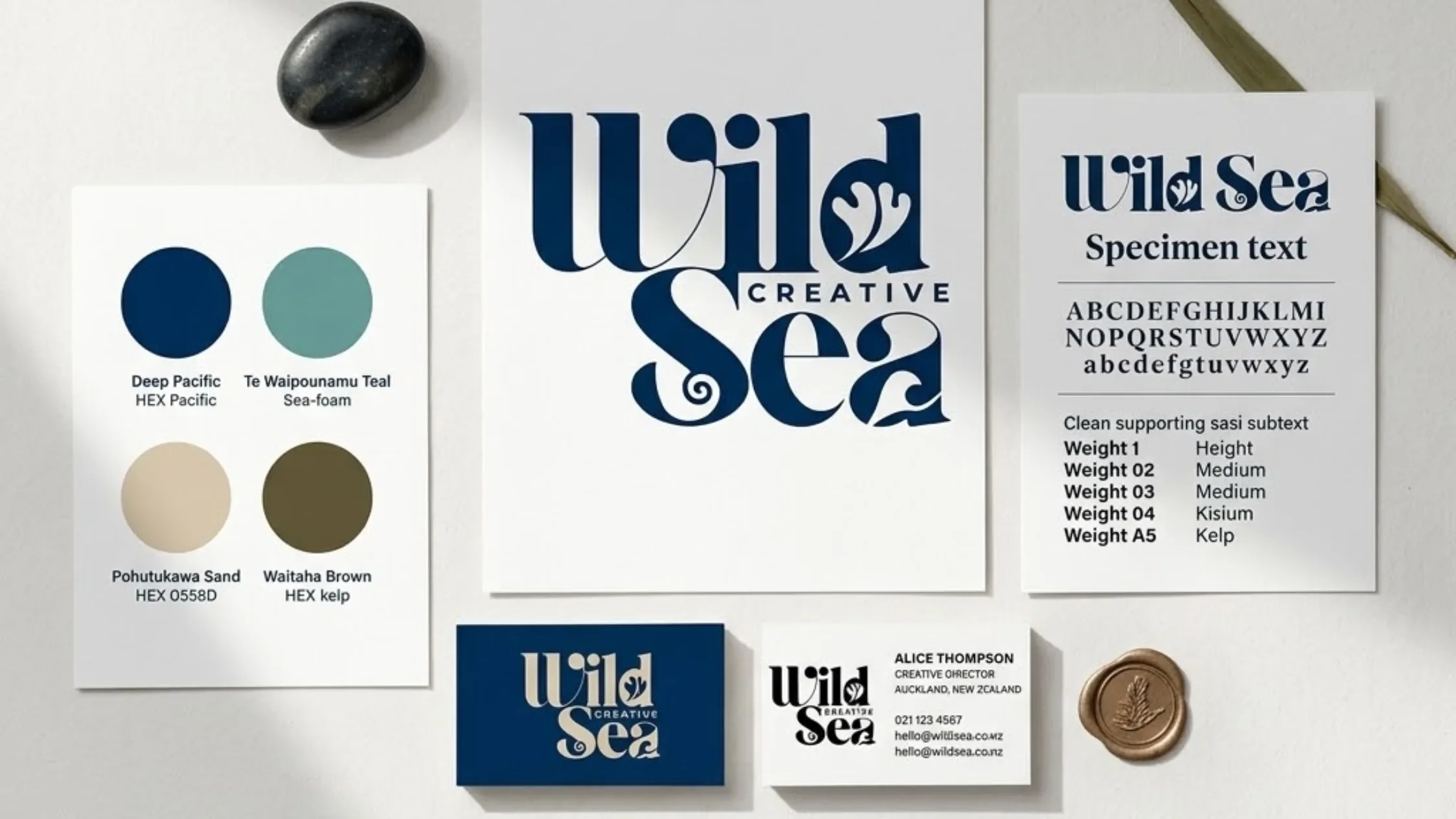
Visual elements: Logo, colour palette, typography, photography style, and iconography
Verbal elements: Brand voice, tone of writing, tagline, and key messaging
Experiential elements: How clients feel when they interact with you across email, social media, your website, and in person
Positioning: The specific niche or market position you occupy in your industry
When all of these elements are aligned, something powerful happens. Your business starts to feel familiar and trustworthy even to people who have never heard of you before. That is because cohesion signals competence. It tells a potential client, before they even read a word, that you know what you are doing.
If you want to understand how these pieces fit together strategically, the brand strategy nz small business guide on the Wild Sea Creative blog is a useful starting point for NZ-based businesses working through this process.
How Brand Identity Directly Influences Customer Acquisition
Let us get specific about the mechanisms here, because this is where most articles stay vague.
First Impressions Determine Whether Someone Stays
Studies suggest you have somewhere between 50 milliseconds and 7 seconds to make a first impression online. In that window, a visitor is not reading your about page or checking your credentials. They are feeling something. Polished or sloppy. Relevant or generic. For me or not for me.
A strong brand identity front-loads that emotional decision. It removes friction at the very first moment of contact. A client who lands on a website with a cohesive visual system, clear messaging, and a confident tone is far more likely to keep reading than one who lands on something that feels inconsistent or dated.
It Filters the Right Clients In (And the Wrong Ones Out)
This is the part people often overlook. A bold, specific brand identity will repel some people. That is not a flaw. It is a feature.
When your brand clearly signals who it is for, the people who are not your ideal clients self-select out. You spend less time on discovery calls with misaligned leads, fewer hours writing proposals that go nowhere, and less energy trying to justify your pricing to someone who was never going to say yes anyway.
The businesses that try to appeal to everyone end up resonating with no one. Specificity is not limiting. It is magnetic.
It Shortens the Sales Cycle
When a potential client arrives at your brand having already seen you on social media, read a blog post, and had a positive impression of your visual identity, the sales conversation starts from a completely different place. You are not building trust from scratch. That work has already been done.
This is why the blog content, brand voice, and visual identity all need to work together. Each touchpoint is either reinforcing or undermining the overall impression.

Brand Identity vs. Brand Strategy: Understanding the Difference
These two terms are often used interchangeably, but they are not the same thing, and confusing them can lead to costly missteps.

The most common mistake is skipping brand strategy and jumping straight to identity design. You end up with something that looks great but does not actually speak to your target audience, because nobody paused to ask who that audience really is and what matters to them.
At Wild Sea Creative, the process starts with strategy before a single colour is chosen. If you are curious about how that works, you can explore my services to see the full approach.
Real Outcomes: What Aligned Branding Looks Like in Practice
Numbers matter. Here are the kinds of outcomes that a strategically aligned brand identity can produce for small businesses in New Zealand.
A Nelson-based creative studio that previously had inconsistent messaging across its website and social channels invested in a unified brand identity system. Within three months, qualified lead volume increased by 35%. The enquiries were also better fit, meaning less time wasted on calls that went nowhere.
An eco-conscious product startup used brand positioning to speak directly to sustainability-driven buyers in New Zealand. After their rebrand, online enquiries doubled. Not because they were advertising more, but because their brand was doing the qualifying work before anyone even clicked through.
These results are not unusual. They are what happens when brand identity and customer acquisition are treated as connected strategies rather than separate disciplines.
You can see examples of this kind of transformation in the portfolio of completed projects.
Signs Your Current Brand Identity Is Costing You Clients
Ask yourself honestly whether any of these ring true for your business right now:
You are attracting leads that are consistently not a good fit for your pricing or service
Your visual assets look different across your website, Instagram, and printed materials
Potential clients seem unsure of what you actually do or who you serve
You feel embarrassed sending people to your website
You are winning clients on price rather than on fit or reputation
Your business has grown but your brand still looks like it did when you started
If two or more of those apply, your brand identity is likely working against your customer acquisition efforts rather than supporting them. That is fixable, and the investment pays for itself relatively quickly when you consider the value of even one or two better-fit clients per month.
Wondering whether a rebrand or a refresh is the right move? The about nish page gives you a sense of the philosophy and approach behind Wild Sea Creative, which might help you decide whether it is the right fit.
Things to Know
Brand identity and logo design are not the same thing. A logo is one element of an identity system, not the whole picture.
Brand voice is often the most overlooked part of identity. If your writing sounds inconsistent or generic, it undermines even the strongest visual design.
A brand refresh and a full rebrand serve different purposes. A refresh updates and aligns your existing identity. A rebrand involves a more fundamental repositioning.
New Zealand buyers, particularly in regions like Nelson and the Top of the South, tend to respond well to authentic, values-driven brands. Generic corporate aesthetics often miss the mark locally.
Consistent brand presentation can increase revenue by up to 33%, according to Lucidpress research. Consistency is not just aesthetic. It is commercial.
Brand identity work should always be preceded by strategy. Without knowing your audience, positioning, and goals, design decisions are essentially guesswork.
Ready to Make Your Brand Work Harder for You?
The single most useful next step you can take right now is to audit your brand across every client-facing touchpoint: your website, your social profiles, your email signature, your proposals, and your verbal pitch. Ask yourself whether all of it tells a consistent, confident, specific story. If the answer is no, that is your starting point. Reach out via the contact page to start a conversation about what a strategic brand identity could do for your business.
You can also explore brand voice services nelson nz if you feel your messaging is the weak link rather than your visuals.

Frequently Asked Question (FAQs)
-
Brand identity is what you deliberately put out into the world. Brand image is how your audience actually perceives it.
The goal is to close the gap between the two. When your identity is built strategically and expressed consistently, your image tends to align more closely with your intentions. Many businesses are surprised to discover how differently they are perceived compared to how they think they come across.
-
Most businesses start seeing measurable changes in lead quality within two to three months of launching a refreshed brand identity.
The timeline depends on how much traffic your existing channels are already generating and how significantly the brand has changed. A more dramatic shift tends to produce faster visible results, particularly on social media and through word of mouth.
-
For a strategically developed brand identity with professional design and messaging, NZ small businesses typically invest between $3,000 and $15,000 depending on scope.
Entry-level logo packages sit at the lower end but often exclude the strategic foundation. Comprehensive brand systems that include strategy, visual identity, and brand voice sit higher. The return on that investment, measured in better-fit clients and reduced sales friction, generally justifies the spend within six to twelve months.
-
You can make meaningful improvements on your own, particularly around consistency and brand voice, but professional design expertise tends to produce significantly better outcomes for visual identity.
DIY tools like Canva allow you to create consistent visuals, which is a good starting point. However, without a trained eye and strategic input, it is easy to make choices that look fine in isolation but do not add up to a cohesive system. For businesses at a growth stage, professional help typically pays for itself.
-
Brand identity is arguably more important for service businesses, because the brand itself is often the primary signal of quality before a client can experience the service directly.
With a product, people can hold it, try it, or read reviews. With a service, the brand does the heavy lifting in building pre-purchase confidence. A well-built brand identity for a service business essentially pre-sells the experience before the conversation even begins.
The Bottom Line on Brand Identity and Customer Acquisition
Your brand identity is either quietly working for you around the clock, or it is quietly losing you clients you will never know you missed. The difference between the two is not talent or budget. It is strategy and intentionality.
If your ideal clients are not finding and choosing you at the rate you would like, the answer is almost never more advertising spend. It is a brand that is clearer, more specific, and more aligned with what your best clients actually care about. Start with an honest audit of your current brand, identify the gaps, and take one concrete step this week toward closing them.
