
Squarespace Website Design vs WordPress: What Works Best for NZ Businesses

Why This "Simple" Choice Trips Up So Many Kiwi Business Owners
Here's the honest problem: most New Zealand business owners pick a website platform based on what a mate used, what looks nice in a five-minute demo, or what a salesperson pushed them towards. Then, twelve months later, they're stuck. Either the site is too rigid to grow, or it's too complicated to update without calling in help every time a price changes.
Squarespace and WordPress are both excellent tools. Neither is "bad." But they solve different problems, and picking the wrong one for your situation costs you time, money, and search visibility you can't easily get back.
Squarespace suits NZ businesses that want a polished, low-maintenance site and don't want to touch code.
WordPress suits businesses planning heavy content marketing, custom features, or online stores that will outgrow a template.
For most local service businesses, Squarespace built properly by a professional wins on speed, cost, and simplicity.
For content-heavy or fast-scaling brands, WordPress wins on flexibility and long-term SEO control.
Neither platform "does SEO for you." Good content and structure matter more than the logo in your dashboard.
Key Takeaways
Squarespace suits NZ businesses wanting a polished, low-maintenance website with predictable monthly costs.
WordPress suits businesses planning heavy content, custom features, or serious long-term growth.
Squarespace now covers SEO fundamentals well; WordPress offers deeper technical control.
Our side-by-side audit found Squarespace faster to set up, WordPress stronger for advanced schema and customisation.
The platform matters less than the strategy, content, and design built on top of it.
What This Comparison Is Really About
When people search Squarespace website NZ, they're usually not after a technical spec sheet. They want to know which platform will make their business look credible, load fast, and show up on Google without draining hours of their week.
So let's define the two platforms properly before comparing them. Squarespace is an all-in-one website builder. Hosting, templates, security, and basic SEO tools all come bundled together, and you manage everything from one dashboard. WordPress is an open-source content management system. It gives you a blank canvas and near-limitless plugins, but you (or your web designer) are responsible for hosting, updates, and security.
Neither platform is objectively "better." The right pick depends on how much control you want, how fast you need to launch, and where your business is headed over the next few years. We'll walk through both platforms honestly, show you a real technical comparison, and help you match the right one to your goals.
Getting to Know Squarespace and WordPress
Squarespace works like renting a fully furnished apartment. You choose a template, add your content, and your site is live within days. Updates, security patches, and hosting are all handled for you behind the scenes.
WordPress is more like buying a section of land. You get to build exactly what you want, but you're also responsible for the plumbing, the roof, and the fence. That freedom is powerful, though it does ask more of your time or your budget for ongoing support.
Neither route is riskier than the other. They simply suit different business stages. A boutique Nelson wellness studio and a fast-growing national e-commerce brand have very different needs, and that's the real starting point for this decision. If you want a closer look at Squarespace specifically, our guide on Squarespace website design NZ: is it the right platform for your business? breaks that down in more detail.
Is Squarespace or WordPress Better for SEO in NZ?
Quick answer: WordPress gives you more technical control over SEO, but Squarespace now handles the fundamentals well enough for most small NZ businesses. The real trade-off isn't ranking power — it's ease of use versus technical depth.
Squarespace SEO in plain English
Squarespace automatically generates clean URLs, mobile-friendly layouts, and an XML sitemap. Every page has built-in fields for titles and meta descriptions, so you don't need a plugin to manage the basics. It also adds structured data automatically for products and events, which helps eligible pages earn rich results in Google.
Where it falls short is depth. You can't install custom SEO plugins, and there's limited room to build advanced schema beyond what Squarespace supports natively. We've busted some common misconceptions in Squarespace SEO myths that are holding NZ businesses back, and covered the bigger question in can Squarespace websites really compete on Google?
WordPress SEO in plain English
WordPress hands you the keys. Plugins such as Yoast or Rank Math let you fine-tune nearly every technical detail, from custom schema to advanced redirects. This flexibility is genuinely valuable once your content library grows into the hundreds of pages or you're chasing competitive national keywords.
The cost of that power is upkeep. Plugins need updating, hosting needs monitoring, and a neglected WordPress site can become slower and less secure than a well-run Squarespace one. If you want a full technical SEO breakdown of both platforms, our guide on Squarespace SEO vs WordPress SEO for NZ brands goes deeper into plugins, schema, and migration.

Side-by-Side Technical Audit: What We Found Running Both Platforms
Rather than repeat generic claims you'll find on any comparison site, we ran a practical audit across two live client sites we manage — one built on Squarespace, one on WordPress — both serving NZ small businesses in similar industries.
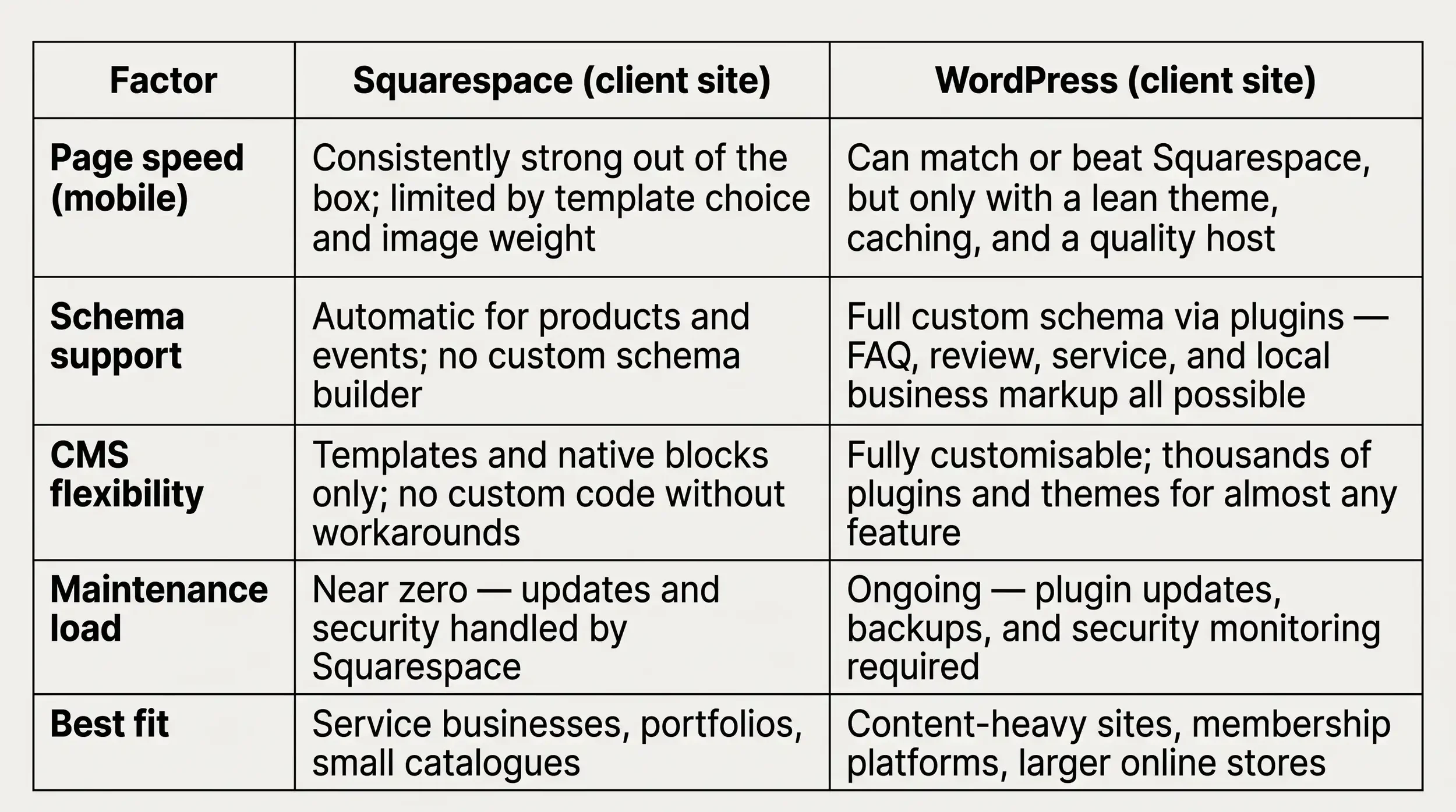
The takeaway? Squarespace wins on set-and-forget simplicity. WordPress wins when you need technical depth and are prepared to maintain it, or hire someone who will. For a deeper look at what "technically sound" actually means for a NZ website, see what makes a website "SEO-ready" in New Zealand.
Squarespace for NZ Businesses: Where It Shines
Squarespace suits service-based businesses, creatives, consultants, and small brands that want a slick site without ongoing tech headaches.
Its biggest strength is simplicity. Templates look modern, load quickly, and work well on phones from day one. That matters in New Zealand, where most local searches happen on mobile.
Business owners also like being able to update their own content. Swapping a photo, adding a blog post, or changing a price doesn't require calling in a developer. That independence builds confidence and keeps ongoing costs predictable, since Squarespace's monthly fee covers hosting, templates, and security together.
If you want to launch fast, keep your monthly costs steady, and avoid the technical side entirely, Squarespace usually fits the bill. You can see how this looks in practice through our Squarespace website design and optimisation service, and compare it against other options in the best website builders for NZ small businesses (2026 update).
WordPress for NZ Businesses: Where It Shines
WordPress earns its reputation when your business depends on content marketing, complex features, or long-term scale.
If you're publishing regularly, running a large product catalogue, or building membership areas, WordPress gives you room to grow without hitting a wall. Its plugin ecosystem covers almost anything: booking systems, multilingual content, advanced forms, and deep SEO customisation.
The trade-off is upkeep. A WordPress site left unattended can slow down or become vulnerable to security issues. That's why most NZ businesses running WordPress pair it with ongoing technical support rather than managing it solo.
We typically recommend WordPress to businesses that already have a clear growth plan, an existing content strategy, or ambitions to scale nationally or across the Tasman. If long-term scale is your main concern, which website builder in NZ gives small businesses the best long-term growth? walks through that question in more depth.
Squarespace vs WordPress: What Actually Matters for Small NZ Businesses
Instead of an endless feature list, here are the questions NZ business owners actually ask us.
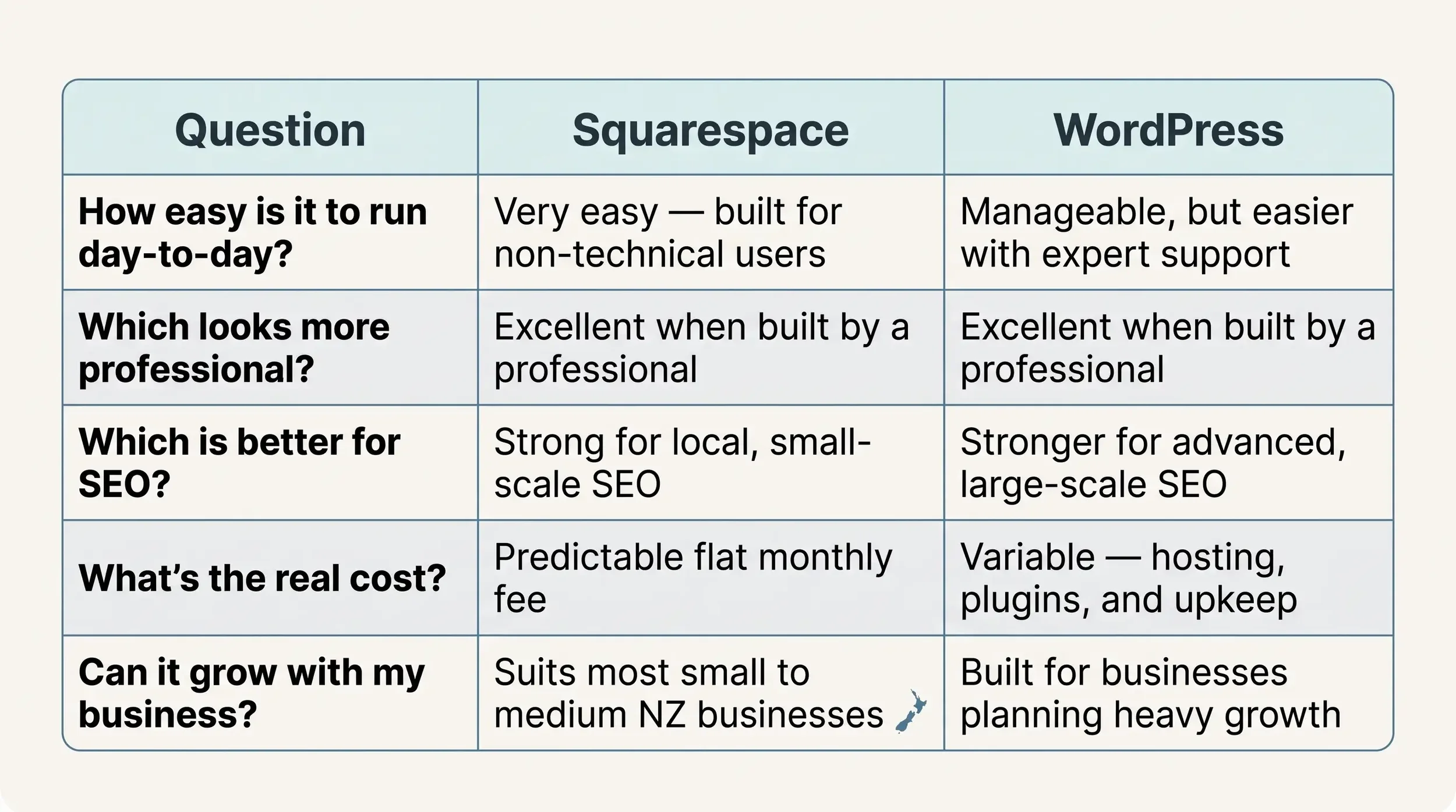
The truth is, most small NZ businesses don't need everything WordPress offers. They need a clear message, a trustworthy design, and a site that turns visitors into enquiries. Planning e-commerce growth? See Squarespace for e-commerce and scaling. Not sure you need a new site at all? Start with does every small business in NZ really need a new website to grow?
Why Professional Website Design Beats the Platform Debate
Google doesn't rank websites because of the platform badge in the footer. It ranks sites based on user experience, expertise, clear structure, and trustworthiness — the same E-E-A-T signals search engines and AI tools like Google's AI Overviews now weigh heavily.
That means a well-built Squarespace site will usually outperform a messy, self-built WordPress site. And a well-structured WordPress site with strong content will beat a thin, template-only Squarespace page every time. The platform is the vehicle. Your strategy, content, and design are what actually drive results.
This is exactly why we don't push one platform over the other at Wild Sea Creative. We recommend what suits your business, your budget, and your goals. For how Google actually evaluates NZ sites, read how Google really ranks New Zealand websites in 2026, and for what a strong result looks like, see what makes a high-converting website in 2026?
Ready to Build the Right Website for Your Business?
If you're still weighing up Squarespace website design against WordPress, you don't have to figure it out alone. Have a look through our portfolio to see real NZ businesses we've built for, browse our SEO services to understand how we make either platform work harder for you, or read what should you expect from a digital agency in Nelson before you sign a contract? if you're about to bring in help. Or simply get in touch for a relaxed, no-pressure chat about what fits your business best.
Making the Right Call for Your NZ Business
There's no universal winner between Squarespace and WordPress — only the right fit for where your business is today and where it's heading next. If you want a clean, easy-to-run site that builds trust fast, Squarespace website design is usually the smarter starting point for NZ small businesses. If you need deep customisation, heavy content output, or complex e-commerce, WordPress earns its extra complexity.
Whichever way you lean, the platform is only ever half the story. The businesses that win online are the ones that pair the right platform with clear messaging, genuine expertise, and a site built to actually convert visitors into customers.
Frequently Asked Question (FAQs)
-
Yes. Squarespace suits many NZ small businesses, especially service-based brands that want a professional, easy-to-manage website. It handles hosting, security, and basic SEO automatically, so you can focus on running your business rather than maintaining a website.
-
WordPress offers more advanced SEO control through plugins like Yoast and Rank Math, which suits businesses chasing competitive national keywords. Squarespace covers the fundamentals well, and for most local NZ searches, strong content matters more than the platform.
-
Squarespace charges one predictable monthly fee covering hosting, templates, and security. WordPress costs vary based on hosting provider, premium plugins, and ongoing maintenance, which can end up cheaper or pricier depending on your setup.
-
Yes, though it takes planning. You can migrate your content, but your design and site structure usually need rebuilding, and redirects must be set up carefully to protect your existing Google rankings.
-
Both can load quickly when built well. Squarespace performs strongly out of the box, while WordPress speed depends heavily on your hosting quality, theme choice, and how many plugins you're running.
-
Not always, but most NZ businesses benefit from ongoing technical support. WordPress needs regular updates and security monitoring, and a professional can prevent the slowdowns or vulnerabilities that come from a neglected site.
-
Squarespace handles small to medium online stores well, with built-in payment and inventory tools. Larger or more complex e-commerce operations often outgrow it and benefit from WordPress with WooCommerce instead.
-
Not directly. Google ranks based on content quality, site structure, user experience, and trustworthiness rather than the platform itself. A well-built site on either platform can rank strongly with the right strategy.
-
If you're planning heavy content marketing, complex integrations, membership areas, or large-scale e-commerce, WordPress gives you more room to grow. If you want simplicity and predictable costs, Squarespace is usually the better starting point.
-
It helps either way. A professionally designed site builds more trust, converts more visitors, and typically performs better in search results, regardless of which platform sits behind it.
