
Why Your Ads Aren’t Converting (Even With High Clicks)
The Missing Link Between Clicks and Customers
It is incredibly frustrating. You open your ad dashboard and see the numbers climbing. Your click-through rate (CTR) looks healthy, and people are clearly interested enough to tap on your headlines. But then, you check your inbox or your sales notifications, and there is nothing but silence. You are paying for the traffic, but that traffic isn't turning into business.
If you have ever felt like you are throwing money into a digital void, you are not alone. Many business owners in New Zealand face this exact hurdle. Having a high CTR but a low conversion rate usually means your ads are doing their job, but your digital "sales pitch" is falling over somewhere else. At Wild Sea Creative, we specialise in finding those cracks in the pavement and sealing them so your marketing budget actually grows your business.
Key Takeaways
Match your message: Ensure your landing page content exactly matches the promise made in your ad.
Simplify the journey: Remove unnecessary steps or long forms that prevent users from converting quickly.
Focus on benefits: Write a copy that explains how you solve the customer's problem, not just what you do.
Test and adjust: Use CRO to find and fix small errors that might be costing you big sales.
Refresh your ads: Avoid ad fatigue by updating your images and headlines regularly to keep your audience engaged.
The Illusion of the High Click-Through Rate
When we see high clicks, our first instinct is to think the campaign is a success. In reality, a click is just an invitation to a conversation. If your ads aren’t converting, it usually means there is a "disconnect" between what you promised in the ad and what the user found when they landed on your site.
Think of your ad as a shop window. If the display is beautiful, people will walk through the door. But if they get inside and find a messy shop, unhelpful staff, or products that don't match the window display, they will walk straight back out. This is the essence of why high CTR low conversion issues happen. You’ve mastered the "hook," but the "hold" is missing.
Is Your Sales Funnel Leaking?
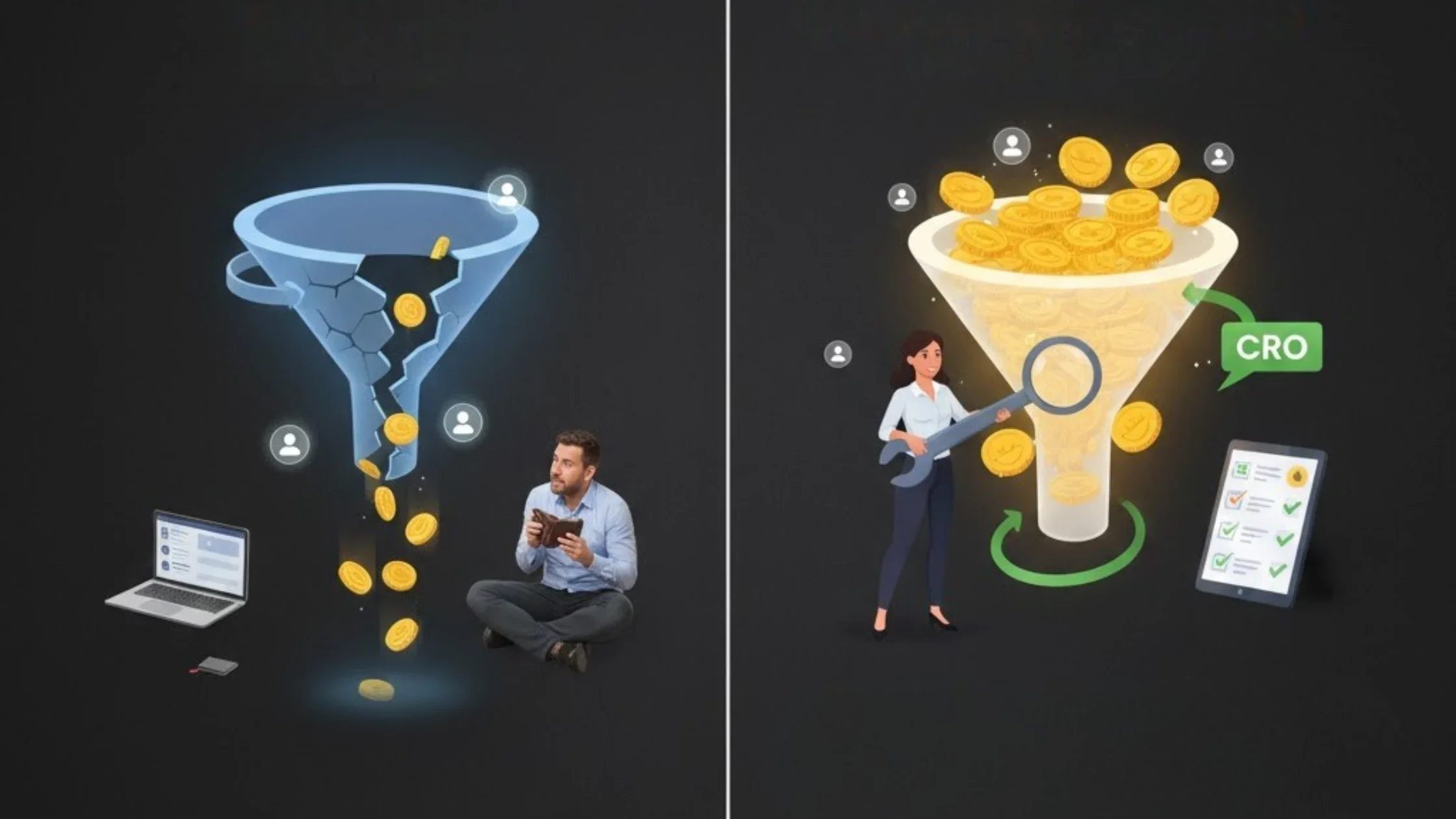
A marketing funnel should be a smooth journey from curiosity to commitment. When ads fail to convert, it’s often because the funnel is "leaky."
One common issue is the "Landing Page Experience." If your ad talks about a specific solution—for example, bespoke website design—but the link sends the user to your generic homepage, you have just given them homework. They have to hunt for the information they were promised. Most people won't bother; they will simply click the "back" button.
To fix this, every ad should lead to a dedicated space that mirrors the ad's message exactly. This consistency builds trust. It tells the visitor, "You are in the right place, and I have exactly what you need."
The Power of Conversion Rate Optimisation (CRO)
If you want to stop wasting money, you need to fall in love with Conversion Rate Optimisation, or CRO. This isn't just a technical buzzword; it’s the art of making it as easy as possible for a customer to say "yes."
Sometimes, the reason people don't convert is remarkably simple. Perhaps your contact form is too long, or your "Buy Now" button is a colour that blends into the background. Other times, it's about speed. If your page takes more than three seconds to load, your potential customer is already gone. At Wild Sea Creative, we look at my services through the lens of the user. We ask: What is stopping this person from taking the next step? By removing these tiny points of friction, we can often double or triple a conversion rate without spending an extra cent on ad traffic.
Messaging: Are You Speaking Their Language?
Your messaging is the heartbeat of your brand. You might have the best product in Nelson, but if your copy focuses on "features" instead of "benefits," you will lose people.
Customers don't buy a drill; they buy a hole in the wall. They don't buy "SEO services"; they buy more time, more leads, and less stress. If your messaging feels mechanical or overly corporate, it won't resonate. We believe in humanising your brand. People buy from people they like and trust. Your landing page copy should feel like a warm handshake and a confident promise that you can solve their specific problem.
Dealing with Ad Fatigue and Trust
If your ads used to work but have recently gone quiet, you might be dealing with "ad fatigue." This happens when your audience has seen your creative assets so many times that they simply tune them out. To keep conversions high, your visuals and headlines need to stay fresh.
Furthermore, Google’s EEAT standards remind us that Trustworthiness is everything. If your landing page doesn’t have testimonials, clear contact details, or a professional look, people will be hesitant to share their information. Trust is earned in seconds. A professional, cohesive brand presence across your ads and your website ensures that when a user clicks, they feel safe enough to convert.
Stop Guessing and Start Growing
You don't have to settle for "good enough" stats. If you are ready to turn those clicks into real-world customers, it’s time to look at the bigger picture. From the first ad impression to the final thank-you page, every step matters.
Let’s bridge the gap together. Whether you need a fresh set of eyes on your funnel or a total overhaul of your messaging, Wild Sea Creative is here to help you navigate the digital waters.
Frequently Asked Question (FAQs)
-
Having high clicks but zero sales usually suggests a "disconnect" between your advertisement and your landing page. While your ad is enticing enough to get a click, the destination page might be confusing, slow to load, or fails to provide the specific information promised in the ad. To fix this, ensure your landing page is highly relevant to your ad copy, features a very clear call to action, and builds trust through professional design and customer testimonials.
-
A "good" conversion rate varies by industry, but generally, a rate between 2% and 5% is considered average. If you are seeing less than 1%, it is a strong signal that you need to invest in Conversion Rate Optimisation (CRO). Improving your conversion rate is often more cost-effective than simply increasing your ad spend, as it allows you to get more value out of the traffic you already have.
-
Page speed is a critical factor in digital marketing success. Most mobile users will abandon a site if it takes longer than three seconds to load. Even a one-second delay can result in a significant drop in conversions. Google also uses page speed as a ranking factor, meaning a slow site can hurt your ad quality score, making your clicks more expensive while simultaneously driving potential customers away.
-
CTR (Click-Through Rate) measures how many people clicked your ad after seeing it, which shows how effective your ad creative is. Conversion rate measures how many of those people actually completed a desired action, like buying a product or filling out a form. A high CTR proves your ads are engaging, but a high conversion rate proves your website and offer are persuasive and user-friendly.
-
Fixing a leaky funnel involves looking at every step a customer takes. Start by checking your analytics to see exactly where people are "dropping off." Is it on the landing page? Or perhaps at the checkout? Simplify your navigation, ensure your website works perfectly on mobile phones, and make your contact buttons very easy to find. Small tweaks to the user experience can lead to massive improvements in results.
-
Yes, visual trust is vital. If a user clicks a professional-looking ad and lands on a website that looks outdated or broken, they will immediately lose confidence in your business. A clean, modern, and mobile-responsive design signals that you are a legitimate and professional service provider. Consistent branding across your ads and website helps build the "Authoritativeness" and "Trustworthiness" required for high conversions.
-
This is often due to "ad fatigue," where your target audience has seen the same message too many times and starts to ignore it. It could also mean your messaging is too focused on your business features rather than the customer's needs. To fix this, try refreshing your headlines and images, and focus your copy on the specific "pain points" your customers are facing and how you can solve them.
-
CRO is the process of increasing the percentage of website visitors who take a specific action. This involves analysing user behaviour, testing different page layouts, and improving copy to make the journey as seamless as possible. Instead of spending more money to get new visitors, CRO focuses on making your existing visitors more valuable by turning more of them into paying customers.
-
Generally, the fewer fields you have, the higher your conversion rate will be. Every extra field you ask a user to fill out is a "friction point" that might make them give up. Only ask for the essential information you need to follow up, such as a name and email address. You can always gather more details later once the initial relationship and trust have been established.
-
Absolutely. Improving conversions is often about "working smarter, not harder." By fixing broken links, improving your page headlines, adding social proof-like reviews, and ensuring your site is mobile-friendly, you can see a significant jump in leads without increasing your daily ad budget. Focus on the user experience first, and the ROI (Return on Investment) will naturally follow.
