
QUICK ANSWER
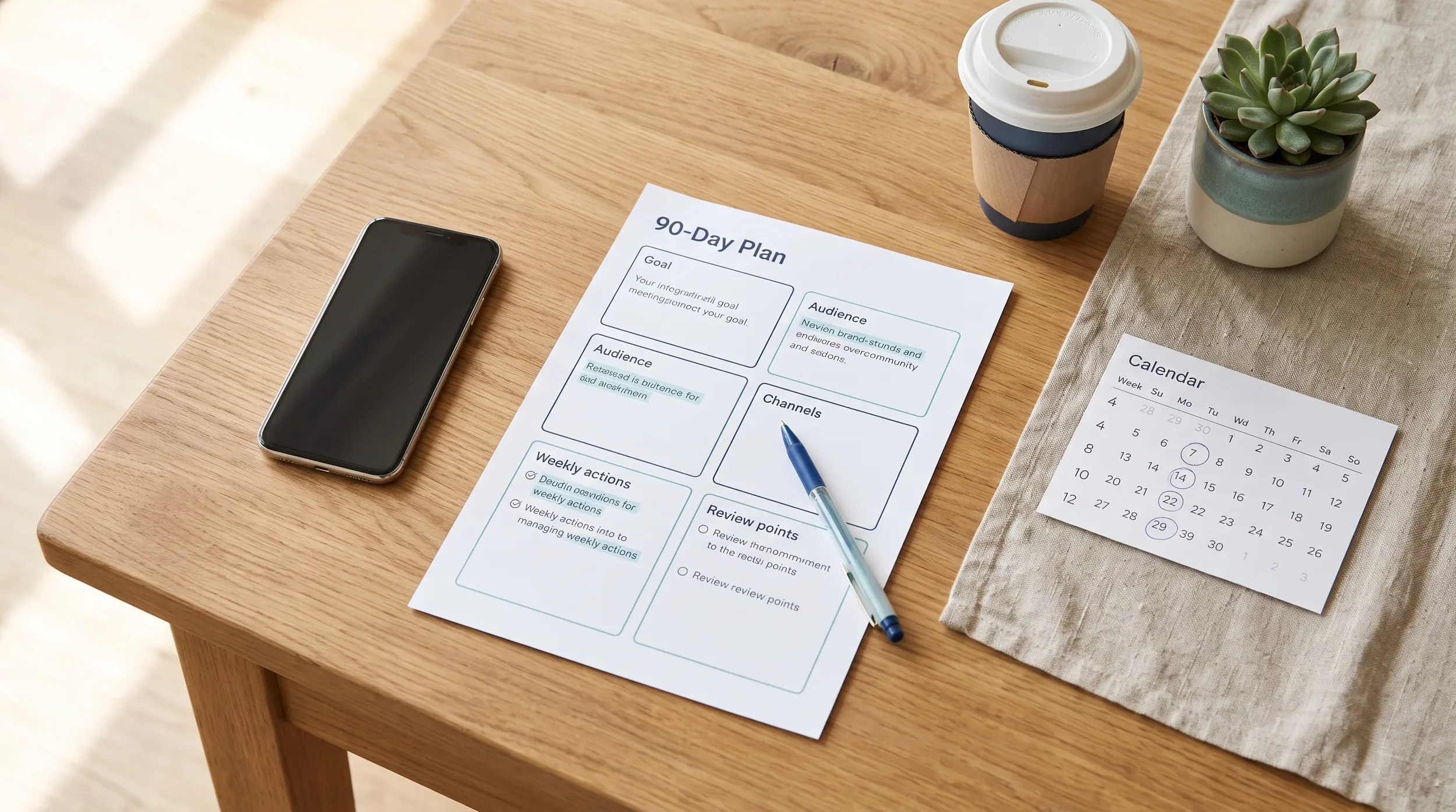
A 90-day marketing plan is a one-page roadmap for the next quarter. To create one, set a single measurable goal, describe the customer you want to reach, choose two or three channels, list the weekly actions that move the goal, and book review points at weeks four, eight and twelve. Then follow it.
KEY TAKEAWAYS
A 90-day marketing plan covers five things: one goal, one core audience, two or three channels, weekly actions and scheduled review points.
Ninety days is long enough to see whether a channel is working and short enough to stay focused, which suits owner-run businesses.
Around 97% of New Zealand businesses have fewer than 20 employees, so the person writing the plan is usually the person doing the work.
The plan should fit on one page and be checked every week; review points at weeks 4, 8 and 12 decide what to keep, fix or stop.
NZ plans need to account for local calendar dips, such as the Christmas–January shutdown, anniversary days, Easter and Matariki.
Most small business owners we speak to in Nelson have tried to write a marketing plan at least once. It usually happens in a burst of January energy. By March, the plan is buried in a folder and marketing is back to posting when there's a spare minute. A 90-day marketing plan fixes that by shrinking the job to something you can actually hold in your head: one goal, one quarter, a handful of weekly actions.
This guide walks you through the exact questions to answer, step by step, with a fill-in framework you can copy today.
What is a 90-day marketing plan?
A 90-day marketing plan is a short, written roadmap that links one business goal to the specific marketing actions you'll take each week for the next three months. It sits between your big-picture strategy and your daily to-do list.
Your strategy explains who you serve and how customers move from first hearing about you to buying. If you haven't mapped that yet, our guide to building a full-funnel digital marketing strategy is the place to start. The 90-day plan then turns that strategy into a quarter of real work: what you'll publish, who you'll contact and how you'll know it's working.
It is not a 30-page document. If your plan won't fit on one page, it's probably trying to do too much.
Why does a 90-day plan work better than a 12-month plan for small businesses?
A 90-day plan works better because small businesses change too quickly for a 12-month plan to stay accurate, and because owners can realistically stay focused for a quarter. A year is a long time to commit to channels you haven't tested.
There's also the question of who does the work. According to MBIE's small business fact sheets, New Zealand had 617,334 businesses in 2025, and 455,730 of them had no employees at all. Business.govt.nz notes that 97% of NZ businesses are small, with fewer than 20 staff. In most of these businesses, the owner writes the plan, creates the content and answers the enquiries. A plan built for a marketing team simply won't get done.
A quarter gives you three useful things:
Enough time to see a trend. One month of data is often noise. Three months shows you whether a channel is picking up.
A natural deadline. Twelve weeks feels close enough that you can't put things off until "later in the year".
A built-in reset. At the end of each quarter, you keep what worked and drop what didn't, instead of carrying dead weight for another nine months.
What goes into a 90-day marketing plan?
Every 90-day marketing plan needs five sections: a goal, an audience, channels, weekly actions and review points. These are the same questions we work through with business owners in our one-on-one marketing coaching sessions, because they force decisions rather than wish lists.
Here's the fill-in framework, a simple small business marketing plan template you can use straight away. Copy the middle column into a document and answer each question in one or two lines.
| Section | Question to answer | Illustrative example (Nelson café) |
|---|---|---|
| 1. Goal | What one measurable result do I want by day 90? | 40 new sign-ups to our loyalty list by 31 March |
| 2. Audience | Who exactly am I trying to reach, and what do they care about? | Locals working within walking distance who want a quick, good lunch |
| 3. Channels | Which two or three places do these people already pay attention to? | Google Business Profile, Instagram, in-store sign-up card |
| 4. Weekly actions | What will I do every week, and when? | Two Instagram posts, one GBP update, ask every lunch customer about the list |
| 5. Review points | When will I check progress, and which numbers will I look at? | Weeks 4, 8 and 12: sign-ups, profile views, post saves |
In our experience at Wild Sea Creative, the goal is the section owners find hardest and the one that matters most. A vague goal like "grow our socials" gives you nothing to measure at week 4. A specific goal, such as "20 booked quotes from our website", tells you which channels to choose and which actions count.
How do you create a 90-day marketing plan, step by step?

Start with what happened last quarter, set one goal, then work forwards through audience, channels, weekly actions and review dates. Block out about an hour of uninterrupted time and work through these steps in order.
Look back at the last 90 days. Before planning forwards, note where your enquiries and sales actually came from. Check Google Analytics, your Google Business Profile insights and simply ask recent customers how they found you. Our guide to choosing marketing KPIs that matter explains which numbers are worth your attention.
Set one primary goal. Make it a number with a date: enquiries, bookings, sales, sign-ups or reviews. You can add a secondary goal, but never more than two.
Describe your audience in plain words. Write who they are, where they are, what problem they have and what makes them choose one business over another. One clear customer beats three vague ones.
Pick two or three channels. Choose the places your customer already looks, not the platform you feel you "should" be on. For many local businesses, that starts with local SEO and a complete Google Business Profile.
Break the goal into weekly actions. List the repeatable tasks for each channel and put them in your calendar with a day and time.
Book your review points. Put weeks 4, 8 and 12 in your calendar now, with 30 minutes for each.
Write it on one page and keep it visible. Print it, pin it or keep it as the first tab in your browser. A plan you can't see is a plan you won't follow.
Weeks 1–4: set up and start
The first month is about foundations. Fix anything that stops people contacting you, such as an outdated Google Business Profile or a broken contact form, set up tracking, and publish your first round of content. Expect small numbers. You're building the base.
Weeks 5–8: build consistency
The second month is where most plans fail, because the novelty wears off before results arrive. Your only job here is to keep showing up on schedule. Use your week-4 review to make one adjustment, not ten.
Weeks 9–12: double down and decide
By the third month, you should see which channel is pulling its weight. Shift your time towards it. In week 12, record what you learned and start drafting the next 90-day marketing plan using those results.
What does a filled-in 90-day plan look like?
A good filled-in plan is short enough to read in a minute and specific enough that anyone could follow it. Here's an illustrative example for a sole-trader electrician in Richmond.
Goal: 15 quote requests from the website and Google Business Profile by the end of the quarter.
Audience: Homeowners in Richmond, Stoke and Nelson planning renovations or needing urgent repairs, who value reliability and clear pricing.
Channels: Google Business Profile, website service pages, review requests by text.
Weekly actions: Monday: one GBP post with a job photo. Wednesday: text a review request to every finished job. Friday: update one service page with a recent example.
Review points: Week 4 (profile views and calls), week 8 (quote requests and reviews), week 12 (quotes, jobs won and where they came from).
Notice what's missing. There's no TikTok, no newsletter and no paid ads. Those might come in a later quarter, once the basics are producing enquiries. If you do add paid search later, our breakdown of how to split budget between SEO and SEM will help you decide how much to put where.
How should NZ businesses plan around the local calendar?

NZ small businesses should map public holidays, school holidays and their own busy season onto the 90 days before setting weekly actions. A plan that ignores the calendar will fall behind in the first month. Overseas templates rarely account for this, so any marketing plan NZ owners write needs to start from our own holiday dates.
If you're writing a plan now, your quarter likely runs through summer. Christmas Day falls on a Friday in 2026, and the Boxing Day holiday is observed on Monday 28 December. The day after New Year's Day is observed on Monday 4 January 2027. Many trades and professional services slow right down across this period, while hospitality and tourism businesses around Nelson Tasman often get busier.
Early 2027 brings Nelson Anniversary Day on Monday 1 February and Waitangi Day observed on Monday 8 February. Easter runs from Good Friday 26 March to Easter Monday 29 March, and Matariki falls on Friday 25 June 2027.
Use these dates in two ways:
Plan lighter weeks around holidays. Don't schedule your biggest push for a week when your customers are at the beach.
Plan content around them. Seasonal moments give you natural reasons to post, email or update your offers, as long as they genuinely relate to your business.
The same thinking applies to your own seasons. A landscaper and a ski-gear shop need very different quarters.
What mistakes derail a 90-day marketing plan?
Most 90-day plans fail because they try to do too much, not because the owner didn't try hard enough. These are the patterns we see most often.
Too many goals. Three goals means three plans. Pick one.
Too many channels. Being average on six platforms rarely beats being consistent on two.
No time in the calendar. If weekly actions aren't scheduled, client work will always win.
Measuring the wrong things. Likes and follower counts feel good, but they don't pay invoices. Track the numbers tied to your goal.
Quitting at week three. Most channels need time to build momentum. Wait for your week-4 review before changing course.
Buying tools before planning. Software won't fix an unclear plan. Plan first, then choose tools. Our 2026 NZ marketing toolkit covers which ones are worth paying for once you know what you need.
When should you get help with your marketing plan?
Get help when you've written a plan but can't decide on the goal or channels, or when you've started two plans and stalled both. Those are signs you need an outside view, not more effort.
At Wild Sea Creative, our coaching is designed for owners who want to run their own marketing with confidence. We start with your goals, your challenges and where you want the business to go, then help you focus on the channels that suit you, set up simple systems you'll actually use and give straightforward feedback along the way. Coaching runs online for businesses across New Zealand and Australia, as well as in person in Nelson.
If you'd rather hand the work over entirely, our team also offers done-for-you digital marketing services, from SEO and social media to email and ads.
Start your next quarter with a plan you'll actually use
A 90-day marketing plan doesn't need to be clever. It needs to be clear, small enough to finish and checked often enough to improve. Set one goal, know your customer, choose two or three channels, schedule your weekly actions and review at weeks 4, 8 and 12. Then do it again next quarter, a little smarter.
Want a second pair of eyes on your plan? Book a free discovery call with Wild Sea Creative and we'll help you shape a quarter that fits your business.
Frequently Asked Question (FAQs)
-
They're closely related. A 90-day marketing plan sets one goal and the actions for the whole quarter. A 30-60-90 day plan is a way of breaking that quarter into three monthly phases, usually setup, consistency and optimisation. Most small businesses benefit from using both: the 90-day goal keeps you focused, and the monthly phases stop you trying to do everything in week one.
-
Yes. A 90-day plan is actually a good first step because it keeps the scope small. Start with one goal, one customer type and one or two channels you already understand, such as Google Business Profile and a single social platform. Use the first month to learn what your customers respond to, then build on that in your second plan.
-
Business.govt.nz offers free business planning resources, including a business plan template with sections that cover your market and goals. For a dedicated marketing plan, a simple one-page document with five headings works well: goal, audience, channels, weekly actions and review points. You can create it in Google Docs, Word or a spreadsheet in a few minutes.
-
One primary goal is ideal, with an optional second goal at most. Each goal needs its own audience, channels and actions, so more goals quickly turn one plan into several. A single goal, such as a set number of enquiries or bookings by a date, makes it much easier to decide what to do each week and whether it's working.
-
It doesn't have to. Start your 90 days whenever you're ready to commit, then set your review points from that date. Some owners like aligning with calendar quarters or their GST periods so marketing reviews happen alongside financial check-ins. What matters most is that the start date, review dates and end date are written down and booked in your calendar.
-
First, check whether you've actually completed the weekly actions. Missed actions explain most stalled plans. If you have, look at where people drop off: are they not seeing you, or seeing you and not getting in touch? Change one thing, such as your offer, your call to action or one channel, then give it until your week-8 review.
-
Absolutely. Sole traders are often the ones who benefit most, because a plan protects limited time. Keep your weekly actions to tasks you can finish in one or two short sessions, batch content where you can, and choose channels that bring enquiries directly, such as Google Business Profile and review requests. A small plan done consistently beats a big plan abandoned.
-
A business plan covers the whole business: what you sell, how you make money, your finances, people and long-term goals. A marketing plan focuses on one part of that, which is how you'll attract and win customers. A 90-day marketing plan is narrower again, turning the marketing section of your business plan into specific actions for the next three months.
-
Yes, but plan it differently. Many NZ trades and professional services quieten from late December into January, so use those weeks for setup tasks like updating your website, photos and Google Business Profile. Hospitality and tourism businesses often need the opposite: lighter planning before Christmas and more customer-facing activity through summer, when visitors are around.
-
Plan backwards from your peak. If your busy season starts in December, your 90-day plan should begin around September, with the first month on setup, the second on building awareness and the third on bookings. In the quiet season, use your plan to collect reviews, grow your email list and update content, so you start the next peak ahead.
