

QUICK ANSWER
Hospitality businesses in New Zealand should plan summer marketing in early November, then work through a week-by-week timeline: update Google listings and holiday hours, launch Christmas function bookings by mid-November, build a summer social media plan with batched content, promote New Year and holiday-period offers, and keep posting through to Waitangi Day in February.
KEY TAKEAWAYS
In New Zealand, Christmas, New Year and the summer holidays all fall inside the same November–February peak, so hospitality marketing has to cover festive and holiday demand at once.
The 2026–27 Christmas and New Year period includes four public holidays, with Boxing Day observed on Monday 28 December 2026 and the Day after New Year's Day observed on Monday 4 January 2027.
State school summer holidays begin no later than Saturday 19 December 2026, and Term 1 2027 starts between 28 January and 3 February, which sets the length of the family travel window.
Domestic travellers account for around 60% of New Zealand tourism spending, so local and regional audiences deserve as much attention as international visitors.
Northern-hemisphere Christmas playbooks built around cosy, indoor, cold-weather imagery do not suit a Kiwi summer of long evenings, outdoor dining and beach days.
Businesses that batch content and lock in bookings before December spend the peak serving customers rather than scrambling for posts.
If you run a café in Nelson, a bar on the waterfront or a kayak tour out of Kaiteriteri, you already know how summer feels. The phone rings, the tables fill and, somewhere between the coffee rush and the dinner service, the marketing quietly stops happening.
That is the trap. The busiest weeks of the year are the worst weeks to start working out your summer marketing ideas NZ customers will actually respond to. The businesses that have a smooth, profitable season usually did their thinking in early November, when there was still time to plan.
This guide gives you a practical, southern-hemisphere timeline for November to February. It covers what to do each week, how a Kiwi summer differs from the northern-hemisphere Christmas advice that floods your feed, and where cafés, bars and tourism operators should focus their energy.
What is a summer marketing plan for hospitality?
A summer marketing plan for hospitality is a dated schedule of the campaigns, content, listings updates and offers a café, bar, restaurant or tourism business will run across the peak season, set out before the season starts.
In practice, it answers three questions in advance: what you will promote, when you will promote it, and who will do the work. That last question matters most. A plan that relies on the owner posting between shifts rarely survives the second week of December.
Why does a New Zealand summer need its own marketing playbook?
Because in Aotearoa, Christmas lands in the middle of summer, not in the middle of winter. Most marketing templates, stock imagery and "holiday campaign" checklists are written for the northern hemisphere, where Christmas is cold, dark and indoors.
In New Zealand, the festive season, the long school holidays, the domestic travel peak and the international visitor season all overlap. That changes your messaging, your imagery and your timing.
| Factor | Northern-hemisphere Christmas playbook |
New Zealand summer playbook |
|---|---|---|
| Season | Winter: short days, cold weather | Summer: long evenings, warm weather |
| Imagery | Fireplaces, snow, mulled wine, knitwear | Outdoor tables, sunsets, beaches, pōhutukawa in bloom |
| Customer mood | Staying in, seeking warmth | Getting out, travelling, socialising |
| Peak period | Late November to New Year | Late November through to early February |
| After Christmas | January slump in many markets | Holiday traffic often continues through January |
| Key dates | Black Friday, Christmas, New Year | Work Christmas functions, Christmas, New Year, regional anniversary days, Waitangi Day |
| Audience | Mostly locals | Locals, domestic holidaymakers and international visitors at the same time |
The practical takeaway: borrow the structure of a good Christmas campaign, but build the content around what your customers are really doing in December and January — eating outside, celebrating with whānau, and taking road trips.
When should cafés, bars and tourism businesses start summer marketing?
Start in the first week of November. That gives you roughly six weeks before the school holidays begin and enough lead time for work Christmas functions, which are often booked weeks in advance.
For the 2026–27 season, a few dates shape everything else:
State school summer holidays start no later than Saturday 19 December 2026, and Term 1 2027 begins between Thursday 28 January and Wednesday 3 February.
Christmas Day is Friday 25 December 2026. Boxing Day falls on Saturday 26 December and is observed on Monday 28 December.
New Year's Day is Friday 1 January 2027. The Day after New Year's Day falls on Saturday 2 January and is observed on Monday 4 January.
Waitangi Day falls on Saturday 6 February 2027 and is observed on Monday 8 February.
Regional anniversary days add extra long weekends, including Nelson Anniversary Day on Monday 1 February 2027 [VERIFY against your council or Employment NZ].
If you open on public holidays, plan your messaging for those days early. Hospitality businesses may add a public holiday surcharge, commonly 15%, but must display clear signage telling customers about it. Mention it on your website and Google listing too, so nobody is surprised at the counter.
Summer marketing ideas NZ: what does a week-by-week checklist look like?
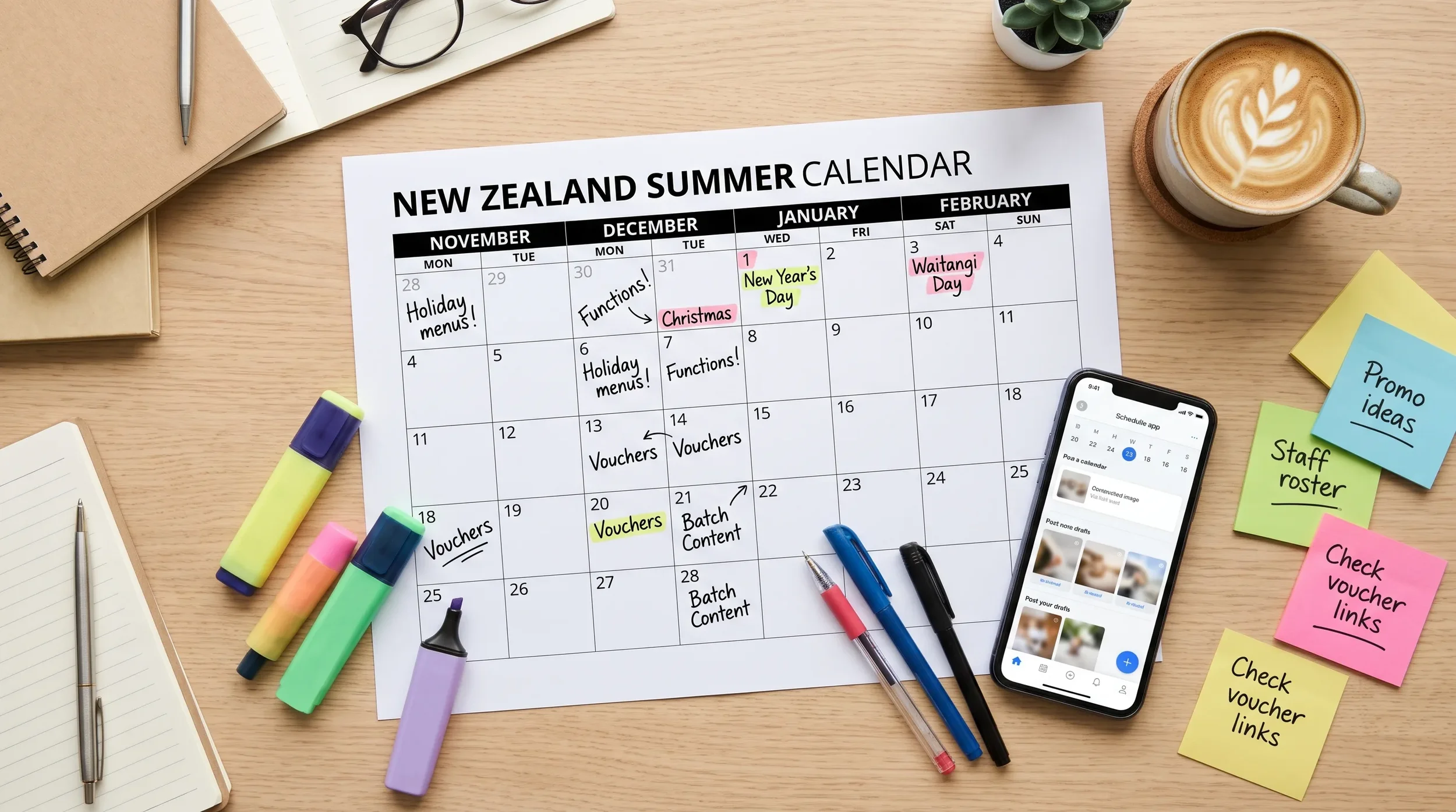
Here is a practical November-to-February timeline. Adjust the detail for your business, but keep the order — each phase sets up the next.
Week of 2 November — audit and plan. Check your Google Business Profile, website hours, menus and booking links. Decide your two or three main summer offers (for example, a Christmas function package, a summer menu and a holiday activity or tour special).
Week of 9 November — launch Christmas function bookings. Publish a dedicated functions page or landing page, post it to social media and email past function customers. Work teams start booking now.
Week of 16 November — batch content. Shoot photos and short videos of your summer menu, outdoor seating, team and venue while you still have quiet afternoons. Aim to bank at least four weeks of posts.
Week of 23 November — set up ads and email. Prepare any paid campaigns for functions, gift vouchers and holiday bookings. Schedule your December emails in advance.
Week of 30 November — push gift vouchers. Vouchers suit Christmas gifting and bring customers back in the quieter months. Promote them on social, in-store and in email.
Week of 7 December — update holiday hours everywhere. Add Christmas and New Year opening hours to your Google Business Profile, website, social profiles and booking platforms.
Week of 14 December — shift to "holiday mode" content. As schools finish, move your messaging from work functions to families, visitors and long summer evenings.
21 December to 4 January — serve, share and respond. Post lighter, real-time content (busy tables, sunsets, specials) and reply to every review. Your batched content carries the load.
Week of 4 January — refresh for the second half of summer. January holidaymakers are still arriving. Update offers, photos and posts so your listings don't look stuck on Christmas.
Late January to 8 February — anniversary days and Waitangi weekend. Promote long-weekend hours and offers, then gather reviews, photos and results to plan next year.
What should be on your listings checklist before December?
Accurate public holiday hours on Google Business Profile, Facebook and Instagram
Current menu, prices and booking links
At least 10 fresh photos showing summer service, outdoor areas and food
Replies to recent reviews
Clear notes on surcharges, deposits or minimum spends for functions
Search behaviour matters here. In our earlier post on why local SEO matters more in winter, we covered how bad weather pushes people to plan from their phones. Summer works differently: people are out and about, but they are still checking Google Maps before they choose where to eat or what to book — especially visitors who don't know the area.
How should you build a summer social media plan?
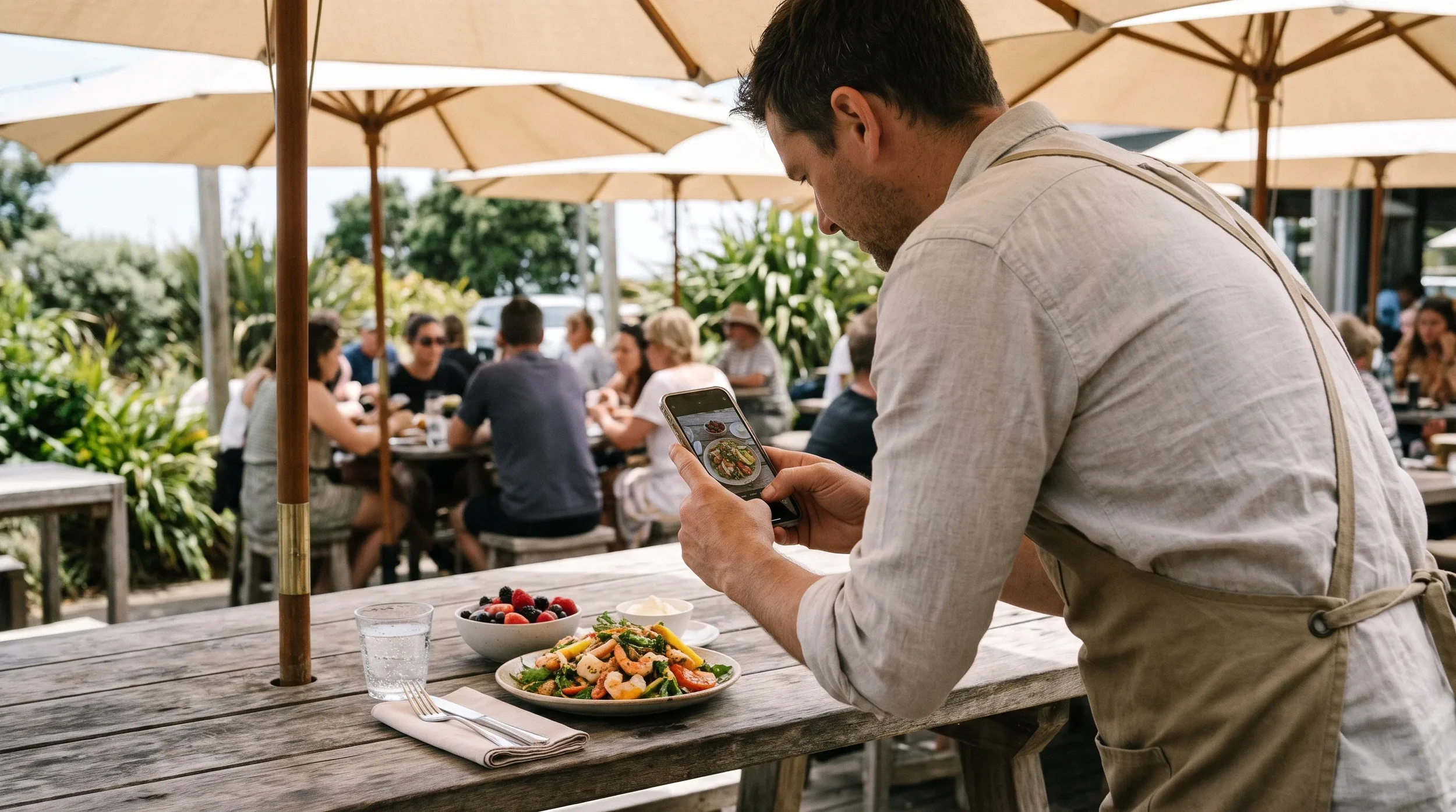
A good summer social media plan is batched, scheduled and simple. It should give you enough planned content to survive the peak without the owner having to create posts between services.
A practical structure for most cafés and bars:
3–5 feed posts a week made up of menu highlights, behind-the-scenes, team stories and offers
Daily or near-daily Stories for real-time content: today's specials, the view, the queue, live music
One clear call to action per week, such as book a function, buy a voucher or reserve a table
A content bank of pre-made posts for the 21 December to 4 January stretch, when time disappears
Keep it local and specific. A post showing your actual deck at golden hour will usually outperform a generic "Happy Holidays" graphic. If you want help shaping the plan, our social media marketing services are built around exactly this kind of organic, local content.
What Christmas marketing works for hospitality businesses in New Zealand?
Christmas marketing for hospitality works best when it sells an experience and a date, not just a discount. People are booking a work function, a family catch-up or a celebration with friends, and they want to know it will be easy.
Ideas that suit Kiwi venues:
Function packages with clear per-head pricing, menu options and deposit terms
Gift vouchers promoted as an easy present for locals and staff
Summer Christmas menus built around seasonal produce, seafood, salads and berries rather than heavy roasts
Christmas Eve and New Year's Eve events with ticketing or bookings
"We're open" messaging for the days between Christmas and New Year, when many people are looking for somewhere to go
Send people to a focused booking page, not your homepage. Our guide to landing page psychology and conversion design explains why a single, clear page converts better than a general one.
How can tourism businesses market to both domestic and international visitors?
Run two parallel tracks. Tourism marketing NZ operators get the best results when they speak to locals and domestic travellers in one voice and to international visitors in another.
The domestic market is too big to ignore. Domestic tourism makes up around 60% of total New Zealand tourism spending, and three in five New Zealanders took an overnight domestic trip in the six months to October 2025. International demand is strong too: overseas visitor arrivals reached 3.51 million in 2025, up 6% on 2024.
For domestic travellers, focus on:
School holiday activities, long weekends and family-friendly offers
"Locals' deals" or off-peak pricing in early December and late January
Social content that shows real Kiwi families and groups enjoying the experience
For international visitors, focus on:
A fast, mobile-friendly booking path with clear pricing in NZD
Google Business Profile photos, reviews and accurate hours
Content that answers practical questions: how long the tour takes, what to bring, whether it runs in rain
Reviews matter to both groups. Make a habit of asking happy customers for a Google review on the day, while the experience is fresh. If you're new to how local search works, our complete guide to local SEO in New Zealand covers the fundamentals.
Which summer marketing mistakes cost hospitality businesses the most?
The most expensive mistakes are timing mistakes. They happen when planning starts too late or stops too early.
Starting in December. By then, many work functions are already booked elsewhere.
Forgetting holiday hours. An out-of-date Google listing sends hungry customers to a closed door and earns a bad review.
Copying northern Christmas imagery. Snowflakes and log fires look out of place in a 25-degree December.
Going silent after New Year. January is still busy in many regions, and visitors are still searching.
No email list. Social reach fluctuates. An email list of past customers is yours to keep, and simple marketing automation for small businesses can send your function and voucher reminders for you.
Measuring nothing. If you don't track bookings, voucher sales and enquiries by channel, you can't plan next summer any better.
What do we see working at Wild Sea Creative?
In our experience at Wild Sea Creative, the hospitality and accommodation businesses that have the smoothest summer are the ones that treat November as their marketing month. [VERIFY with Nish]
A few patterns stand out from working with Nelson and Tasman businesses:
Organic first, ads second. Consistent, real content builds trust before peak season. Paid ads then amplify offers that already have proof behind them.
Batched content beats daily scrambling. A month of planned posts, created before the rush, is the single biggest stress reducer for busy owners.
Specific beats generic. Posts that show your real venue, your team and your view tend to earn more engagement than templated holiday graphics. [VERIFY with Nish]
One offer, one page, one call to action. Campaigns perform best when each offer has its own focused destination.
When it comes to seasonal campaigns that need a stronger visual push, our creative ads, assets and campaigns service can produce the imagery, copy and rollout plan in one go.
Ready to plan your summer marketing?
Summer is too short and too valuable to wing it. The right summer marketing ideas NZ hospitality businesses can rely on are simple: start early, keep listings accurate, batch your content, and speak to locals and visitors in their own terms.
If you'd like a hand building your summer plan, Wild Sea Creative can help with strategy, content and campaigns — or coach you to run it yourself. Get in touch for a free discovery chat, and let's make this your best summer yet.
Frequently Asked Question (FAQs)
-
Start planning Christmas marketing in early November, around six to eight weeks before Christmas. That gives you time to publish function packages, shoot fresh photos and schedule emails before work teams make their bookings. Cafés that start in December often find the larger Christmas functions have already been booked elsewhere, so earlier is almost always better.
-
The most effective low-cost ideas are updating your Google Business Profile with fresh photos and holiday hours, posting real behind-the-scenes content on Instagram and Facebook, emailing past customers about gift vouchers, and asking happy customers for reviews. None of these need an ad budget, but together they keep you visible to locals and visitors searching for somewhere to go.
-
Paid ads can work well over summer, especially for function packages, gift vouchers and tour bookings with a clear deadline. They work best once your organic presence is strong, with good photos, recent reviews and a focused landing page. Without those foundations, ads often send people to a profile that doesn't convince them to book.
-
Run separate messages for each audience. Locals respond to loyalty offers, events and "we're open" updates during the holiday weeks, while visitors need clear booking information, directions and reviews. Many venues also offer locals-only specials in the shoulder weeks of early December and late January to keep regulars coming back.
-
Keep it light and real-time. Post Stories of busy tables, daily specials, the view and your team, and reshare customer posts where you have permission. Have a few pre-made feed posts scheduled so you don't need to create content during your busiest days, and make sure your opening hours are pinned or highlighted.
-
Hospitality businesses can choose to add a public holiday surcharge, commonly around 15%, to help cover higher staff costs. If you do, you must display clear signage so customers know before they order. It is also worth stating the surcharge on your website and Google listing to avoid complaints or negative reviews.
-
For the 2026–27 summer, state school holidays start no later than Saturday 19 December 2026. Term 1 2027 begins between Thursday 28 January and Wednesday 3 February, depending on the school. That gives tourism and hospitality businesses roughly five to six weeks of peak family travel.
-
Australia shares the southern-hemisphere summer Christmas, so the seasonal imagery and timing are similar. The key differences are public holiday dates, school holiday schedules, which vary by state, and audience behaviour in each region. Businesses targeting both markets should plan separate calendars rather than assuming the same dates apply.
-
Track bookings, function enquiries, gift voucher sales, Google Business Profile calls and direction requests, website visits from social and ads, and new reviews. Compare each against last summer where possible. These numbers show which channels drove revenue, so you can put more effort into what worked when you plan next November.
-
It isn't too late, but you will need to prioritise. Update your holiday hours and Google listing immediately, promote gift vouchers and New Year events, and batch a few weeks of simple content. You may miss some early function bookings, but January holiday traffic still gives you plenty to work with.
