
How AI Tools Can Level Up Your Marketing in 2026: NZ-Focused Ideas

AI Is Everywhere, but Is It Actually Helping Your Marketing?
Here's the honest truth: most NZ small businesses are already using AI, but very few are getting real value from it. You've probably asked a chatbot to write a caption, got something bland and a bit American back, and gone back to doing it yourself. Or you've switched on an "AI" button in your ads account and hoped for the best. That's not a failure on your part. It's what happens when a tool arrives without a plan.
AI marketing tools are software that uses artificial intelligence to help with marketing jobs such as writing, designing, understanding customers, running ads and replying to messages. Used well, they give you back hours every week and help a small team punch well above its weight. Used badly, they churn out generic content, burn your ad budget and can even put your customers' privacy at risk.
AI helps NZ and Australian businesses most in three areas: creating content faster, understanding customers better and running ads more efficiently. Start with one job, give the AI clear instructions and your brand voice, and always keep a human check before anything goes live. Never paste private customer details into free AI tools. We dropped Copy.ai from our own workflow this year, and we explain what replaced it below.
Key Takeaways
AI helps most with content, customer insight and ad optimisation.
Give AI your brand voice guide and always edit before posting.
Use AI to polish real photos, not fake them.
Fix your conversion tracking before trusting AI ad campaigns.
AI speeds up SEO research but doesn't replace SEO know-how.
Never paste private customer data into free AI tools.
Start with one job, measure it, then add the next.
What AI Marketing Tools Actually Do for NZ Businesses
Think of AI as a fast, keen junior assistant: great at first drafts and number-crunching, but it still needs your direction and local knowledge. It doesn't know your customers, your town or your reputation. You do.
This guide is about how to put AI to work, not which subscriptions to buy. If you want our full, tested list of marketing software, including analytics, CRM and design tools, head to our 2026 Marketing Toolkit for NZ brands. Here's how to use AI well, safely and step by step.
Why NZ Businesses Can't Ignore AI Marketing Anymore
AI marketing in NZ has moved from nice-to-have to normal, and many of your competitors are already using it. A small team with good AI habits can now produce the content, emails and ad tests that once needed a full marketing department. That levels the playing field for small Kiwi teams.
The good news is you don't need to be first; you just need to be deliberate. Businesses that pick one or two jobs, set AI up properly and keep checking results are the ones pulling ahead. It needn't cost much either, because many of the AI features you need are already built into tools you pay for, such as your email platform, Canva and your ad accounts.
Where Does AI Actually Help NZ Marketing in 2026?
AI gives NZ businesses the biggest return in three areas: content creation (drafting words and visuals faster), customer insight (spotting patterns in who buys and why) and campaign optimisation (letting ad platforms and email tools adjust targeting and timing for you). Everything else, from chatbots to AI search, builds on those three foundations.
The six ideas below follow that order. Pick the one that solves your biggest time drain first, get it working, and then move on to the next.
Idea 1: Write Faster Without Losing Your Kiwi Voice
AI is brilliant at first drafts, but only if you tell it who you are. Ask a general AI assistant to "write a Facebook post about our winter sale" and you'll get something that could belong to any business anywhere in the world.
Brief AI like you'd brief a new staff member
The fix is a proper brief. Give the AI your brand voice guide, three examples of posts you're proud of, and clear instructions such as "use New Zealand English spelling", "keep sentences short" and "mention that we're locally owned in Richmond". Most AI assistants now let you save these instructions in a project or custom setup, so you don't have to paste them in every time. If you don't have a written voice guide yet, our article on what brand voice really means is a good place to start, and our brand voice services can build one for you.
Keep a human in the loop
Always read, edit and fact-check before you post. AI can confidently get prices, opening hours, local place names and te reo Māori wrong. A quick human edit is what turns a generic draft into something your customers trust. If writing still feels like a chore, our copywriting services and content creation services can take it off your plate.
Swapped out in 2026: Copy.ai → a general AI assistant with a saved brand voice Copy.ai used to be our go-to suggestion for quick marketing copy. We've dropped it from our small-business recommendations this year. Copy.ai has shifted its focus towards sales and go-to-market workflows for larger teams, which is great for them but more than most small NZ businesses need. We now set clients up with a general AI assistant (the one they already use is usually fine) and save their brand voice guide, example posts and NZ spelling rules inside it. It costs less, and because it's trained on their examples, the drafts sound far more like them.
Idea 2: Create Visuals and Short Videos in Minutes
AI design tools let you turn one photo or idea into a week's worth of social graphics. Canva's Magic Studio can resize designs, remove backgrounds and suggest layouts, while Adobe Firefly can generate or extend images and is designed to be safe for commercial use.
Use AI to edit, not to fake
Use AI to tidy up real photos of your team, products and projects, rather than inventing them. Under New Zealand's Fair Trading Act, you can't mislead customers about what you sell, and an AI-generated "product photo" that looks nothing like the real thing could land you in trouble. Real photos, polished with AI, build far more trust than perfect fake ones. For bigger campaigns, our creative ads and assets team can help.
Idea 3: Understand Your Customers Better
AI can spot patterns in your customer data that would take you days to find by hand. Email platforms such as Klaviyo and HubSpot now use AI to predict who's likely to buy again, who's at risk of drifting away and the best time to send each person an email.
Put segmentation to work
Picture a Nelson gift shop with an online store. AI notices that customers who buy candles in autumn often come back for gift sets before Christmas. The shop sets up an automatic email in November for just those customers, rather than blasting everyone. That's smarter segmentation, and it usually means better results with fewer emails. Our guide to the ROI of email segmentation explains how to set this up, and our customer journey mapping guide helps you see where AI fits in each stage. If you'd rather hand it over, explore our email marketing services.
Send the right email at the right time
AI inside tools like Mailchimp and Klaviyo can also suggest subject lines, test two versions for you and send each email when that person usually opens their inbox. For Kiwi businesses, that often means more opens and fewer unsubscribes without writing extra emails. Just check that every AI-suggested subject line still sounds like you, and skip clickbait that damages trust.
Idea 4: Let AI Fine-Tune Your Ads
Google and Meta both run AI-powered campaign types that adjust targeting, bids and creative for you. On Google, Performance Max and AI Max for Search campaigns use AI to find more of the right searches. On Meta, Advantage+ campaigns do a similar job across Facebook and Instagram.
Give the AI good signals
Here's the catch for NZ businesses: our audiences are small, and AI needs good data to learn. If your conversion tracking is wrong, AI will happily spend your budget chasing the wrong people. Set up accurate conversion tracking first, add clear exclusions (such as areas you don't serve), and check search terms and placements every week. Watch out for ad fatigue too, as AI can over-use your best-performing ad until people stop noticing it. Our guide to creative fatigue in paid ads shows you when to refresh. For hands-on help, see our Google Ads campaigns and Meta Ads campaigns services.
Test more ideas, faster
AI makes it quick to write several versions of an ad headline or social post, so you can test what your audience actually responds to instead of guessing. Run two or three versions at once, let them gather results for a week or two, then keep the winner.
Idea 5: Reply to Customers Faster With Chat Automation
Speed wins enquiries, and AI chat tools help you reply in seconds, even at 10pm. Tools like ManyChat can answer common Instagram and Facebook messages automatically, such as opening hours, prices or booking links, and pass trickier questions to you.
Always offer a human handover
Keep automated replies short, friendly and honest about being automated. Make it easy for customers to reach a real person, especially for complaints or anything sensitive. Automation should make you easier to reach, not harder. For a wider look at automating follow-ups on a small budget, read our guide to marketing automation for NZ SMEs, and if your social channels need a fresh plan, our social media marketing services can help.
Idea 6: Get Found in Search and AI Answers
AI isn't just a tool you use; it's also how your customers now find you. Google's AI Overviews and chat assistants like ChatGPT answer questions directly, often naming a few businesses as sources.
Show up in AI answers
To show up in those answers, your website needs clear, helpful content that answers real customer questions, plus accurate business details across Google Business Profile and trusted local directories. Our guide to how Google ranks NZ websites in 2026 explains what matters, and our SEO strategy services are built for both traditional and AI search.
Use AI to plan smarter SEO content
AI also makes SEO research faster. It can group keyword ideas, list the questions your customers ask and outline a page that covers a topic properly. SEO tools such as Surfer and Semrush now build AI into their audits and content suggestions too. AI doesn't replace SEO know-how; it speeds it up. You still need local knowledge, real experience and a clear plan. For our tested picks, see the top 5 SEO tools every NZ small business should use in 2026.

Using AI Safely: Privacy Rules for NZ and Australian Businesses
If you use AI with customer information, New Zealand's Privacy Act 2020 still applies, and so does your customers' trust. The Office of the Privacy Commissioner has published clear expectations for businesses using generative AI, and in Australia, the OAIC has released similar guidance.
In plain terms, don't paste names, phone numbers, emails or purchase histories into free AI tools, check where a tool stores your data before you connect your CRM, and tell customers when they're chatting with a bot. Here's a simple way to decide what's safe.

Your 30-Day Plan to Start Using AI
The fastest way to get value from AI is to start small and measure. Here's a simple plan you can follow this month.

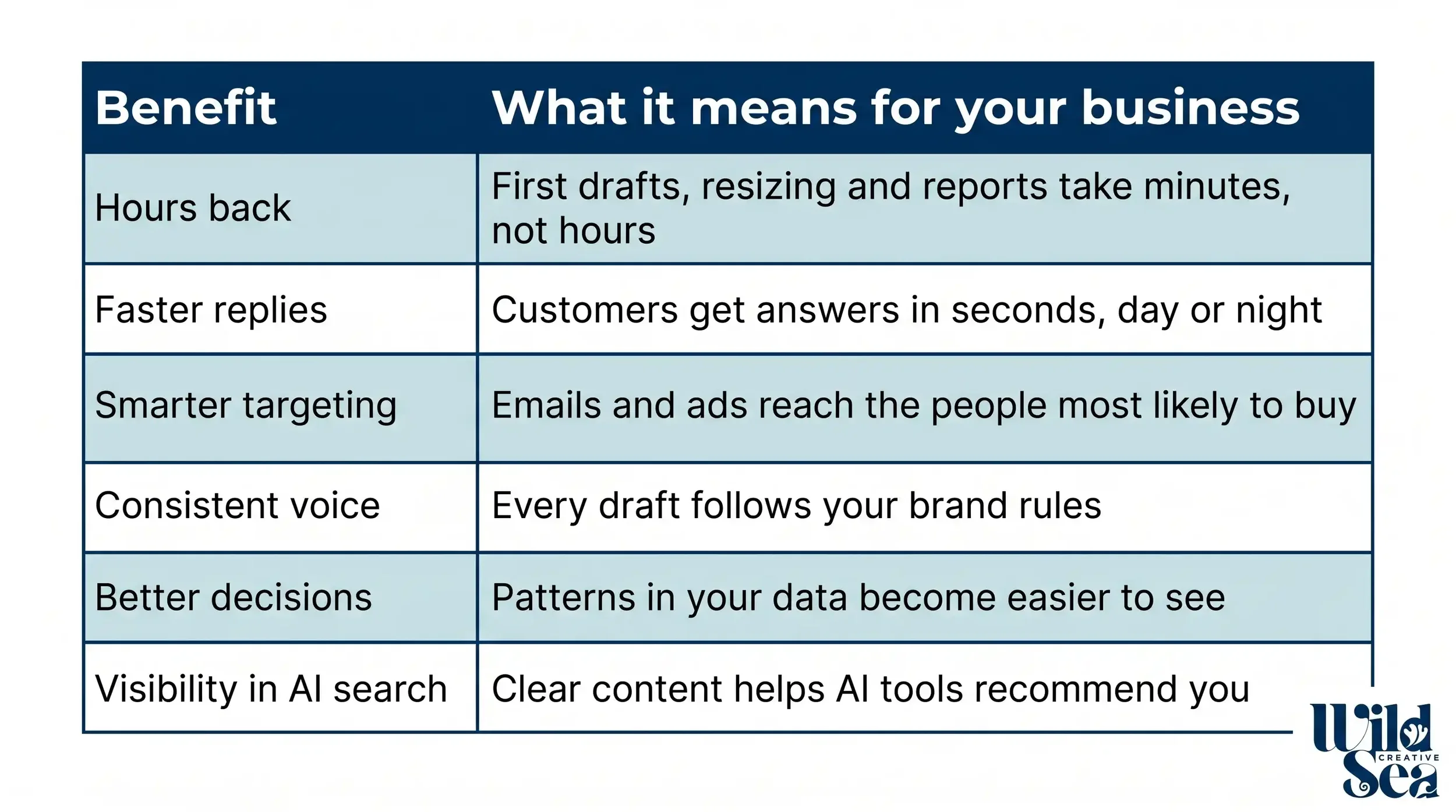
Key Benefits of Using AI the Smart Way
When AI is set up properly, the gains are real and easy to feel in your week.
Let's Put AI to Work in Your Marketing
You don't need to become a tech expert to get real results from AI. At Wild Sea Creative, we help NZ and Australian businesses pick the right AI jobs, set them up safely and keep every word sounding like you.
If you'd like a clear starting point, a session of marketing coaching will help you choose where AI fits in your business. Prefer to hand it over? Browse our full range of digital marketing services, or learn more about Nish and the Wild Sea Creative approach.
👉 Book a free discovery call with Wild Sea Creative and we'll map out your first 30 days with AI together.
Smart AI, Human Touch: Your Winning Mix for 2026
AI won't replace what makes your business special, but it can free up the time you need to do more of it. Start with one job, brief the AI properly, keep a human check on everything and protect your customers' privacy. Do that, and AI stops being a gimmick and becomes a genuine helper for your marketing.
Ready to see where AI could save you the most time? Get in touch with Wild Sea Creative today.
Frequently Asked Question (FAQs)
-
The best AI marketing tools depend on the job. A general AI assistant with your brand voice saved is great for writing. Canva's Magic Studio and Adobe Firefly help with visuals. Klaviyo and HubSpot use AI for customer insights, and Google and Meta's AI ad campaigns help with targeting. Start with the tool that saves you the most time, then add others once it's working well.
-
For written content, a general AI assistant such as ChatGPT, Claude or Gemini works well when you save your brand voice guide and NZ spelling rules. Jasper suits larger marketing teams. For visuals, Canva's Magic Studio and Adobe Firefly are popular choices. Whatever you use, always edit the drafts yourself so they sound local, accurate and genuinely like your business.
-
Most AI marketing tools are global, so support is usually online. Canva was founded in Australia and supports customers in local time zones, and HubSpot has an Asia-Pacific base in Sydney. For hands-on help, a New Zealand digital agency can set up the tools, train your team and troubleshoot problems in your time zone, which many small businesses find far easier than working alone.
-
Popular options include Meta Business Suite, which is free and has built-in AI caption help, plus Buffer, Later, Planable and Hootsuite, which all offer AI features for captions and timing. ManyChat automates replies to Instagram and Facebook messages. Most are global platforms used widely by NZ businesses, so compare pricing in NZ dollars and try a free trial before committing.
-
Independent review sites such as G2, Capterra and Trustpilot collect real user reviews and let you compare tools side by side. Ask other NZ business owners in local business groups what they actually use. Most tools also offer free trials or free plans, which is the best test of all. Try it on a real task for a week before you pay for a full year, and note how much time it genuinely saves.
-
AI looks at what, when and how often customers buy, then groups them automatically. Platforms like Klaviyo can predict who's likely to buy again, who's drifting away and when each person usually shops. You can then send the right offer to the right group, such as reminding past gift buyers before Christmas, rather than emailing everyone the same message. Fewer, better-timed emails usually mean more sales.
-
Yes. AI can draft captions, suggest the best posting times, resize graphics for each platform and spot which posts perform best. Meta's Advantage+ campaigns also use AI to find the right audience for paid posts. The key is giving AI your brand voice and checking everything before it goes live, so your posts still sound local, personal and true to your brand, not generic.
-
HubSpot suits businesses wanting CRM, email and AI tools in one place, with a free plan to start. Klaviyo is strong for e-commerce, with AI predictions for repeat buyers. ActiveCampaign offers detailed email journeys with AI help, and Mailchimp is simple and familiar for newsletters. Compare features against your main goal and check how pricing grows as your list grows.
-
Start with low-cost, easy wins: a general AI assistant for drafting posts and emails, Canva for AI-powered design, and the free AI features already inside your email and ad platforms. These cover most small business needs without big new costs. Add specialist tools only when you have a clear problem to solve and time to learn them properly. Small steps beat big, unused subscriptions.
-
Google Ads and Meta Ads both include AI campaign types, such as Performance Max, AI Max for Search and Advantage+, which you can run yourself. For better results, many NZ businesses work with a local agency that sets up tracking, feeds the AI good data and checks performance weekly. Look for a partner who reports on real leads and sales, not just clicks and impressions.
