
The Content Marketing Funnel: Building Awareness to Conversion in New Zealand

The Problem With "Just Posting Content"
Here's an honest truth: most New Zealand businesses aren't short on content. They're short on a plan for what that content is supposed to do. You post a blog here, a social update there, maybe a newsletter when you remember — and yet the phone still isn't ringing the way you hoped.
That's not a content problem. It's a funnel problem. Without a clear path from "someone just found you" to "someone just paid you," even great content ends up doing very little. This guide breaks down exactly how a content marketing funnel in New Zealand works, stage by stage, so every blog post, email and social update has a job to do — and does it.
A content marketing funnel guides people through three stages: Awareness (they discover you exist), Consideration (they weigh you up against other options), and Decision (they choose to buy, book or sign up). For NZ businesses, that means blending local search visibility, trust-building content and clear calls to action — tailored to how Kiwi and Australian audiences actually search and shop. Get this structure right, and your content stops being noise and starts being a sales tool.
Key Takeaways
A content marketing funnel has three stages: Awareness, Consideration, Decision
Awareness content should educate and get found — not sell
Consideration content builds trust through case studies, guides and honest comparisons
Decision content needs to remove friction and make the next step obvious
NZ and Australian audiences respond best to funnels built around local search habits and genuine trust
A structured funnel improves lead quality, shortens sales cycles and boosts long-term SEO performance
What Is a Content Marketing Funnel, Anyway?
Think of the funnel like a real, physical one — wide at the top, narrow at the bottom. At the top, lots of people pour in: someone Googling a question, scrolling Facebook, or clicking a link a mate shared. By the bottom, only some of those people remain — the ones ready to become paying customers.
Your content's job is to guide people through that narrowing journey without losing them along the way. A visitor who lands on your site through a Google search about "best coffee roasters in Nelson" isn't ready to buy a subscription box on their first visit. They need a few more nudges — some helpful information, a bit of trust-building, and eventually, a clear reason to act. That's exactly what a well-structured funnel provides, and it's the same logic behind a full-funnel digital marketing strategy for NZ businesses.
For New Zealand and Australian businesses specifically, this matters even more. Our markets are smaller, word-of-mouth still carries huge weight, and local trust is everything. A funnel built for a UK or US audience won't automatically translate here — your content needs to speak to Kiwi search habits, local pain points, and the way people in this part of the world actually make buying decisions.
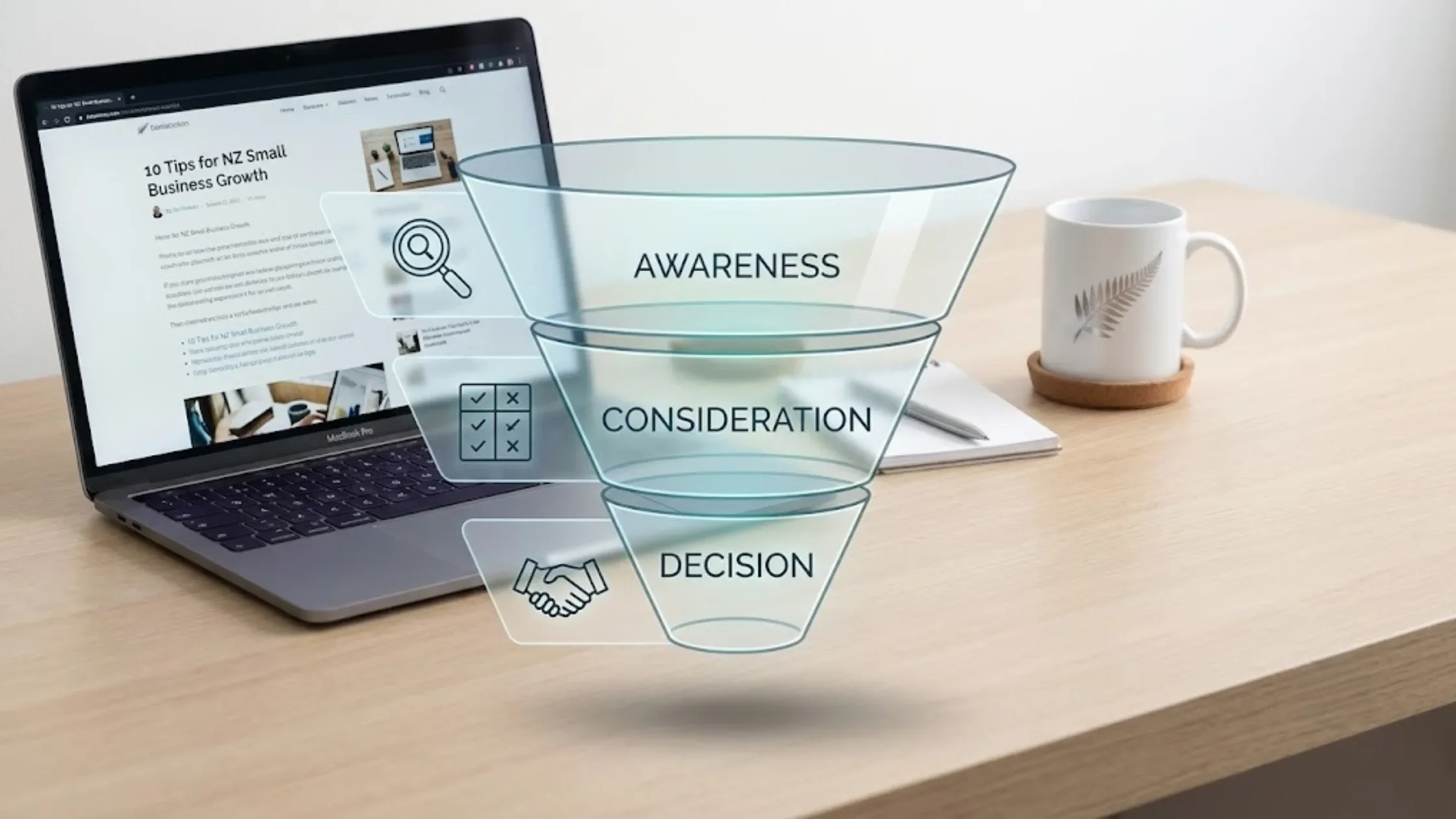
Stage One: Awareness — Getting Found by the Right People
This is the top of the funnel, and it's where most of your audience first meets you. At this stage, nobody is thinking about your pricing page. They're Googling a problem, scrolling for inspiration, or asking a question they don't yet know you can answer.
Your job here isn't to sell. It's to show up, be genuinely helpful, and start earning attention. Blog posts that answer common questions, social content that solves small everyday problems, and search-optimised pages that match what people are actually typing into Google — these all live in the Awareness stage.
For New Zealand businesses, local SEO plays a massive role here. If someone searches "SEO agency near me" or "best florist Nelson," your content needs to be visible in that exact moment. This is why pairing awareness content with strong local SEO strategy for New Zealand businesses makes such a difference — it's not just about writing helpful content, it's about making sure Google (and increasingly, AI search tools) can actually find and recommend it.
A few things that genuinely work at this stage:
Educational blog posts that answer real, specific questions your audience is already asking
Short-form social content that's useful or entertaining, not salesy
Search-optimised landing pages built around how people actually phrase their searches
Guest features, local directory listings and community partnerships that put your name in front of new eyes
The goal is simple: be the business people remember when the problem gets bigger.
Stage Two: Consideration — Building Trust Before the Sale
Once someone knows you exist, they start comparing. This is the middle of the funnel, and it's arguably the most overlooked stage in NZ content strategy. Businesses often go straight from "here's a blog post" to "buy now," skipping the part where trust actually gets built.
At the Consideration stage, your content needs to answer the unspoken question: "Can I trust this business to actually deliver?" This is where case studies, detailed guides, comparison content and testimonials do their heaviest lifting. People aren't just checking what you offer — they're checking whether you understand their specific situation.
This is also where experience and expertise matter most, both to your reader and to Google. Content written by someone who's actually done the work — not just researched it — reads differently. It has specifics, real examples, and small details that can't be faked. If you want to see how that experience translates into results, Nish's background and approach is a good example of what genuine expertise looks like in practice.
Content that performs well here includes:
In-depth guides that go deeper than a quick answer, showing real process and thinking
Case studies with honest numbers and outcomes, not just vague success stories
Comparison content that helps people weigh their options fairly (yes, including competitors)
Email content that nurtures gradually, rather than pushing for an immediate sale
Understanding why someone is searching in the first place also shapes what you write here. A deeper look at search intent strategy for NZ business growth can help you match content to exactly where a reader sits in their decision-making process.
Stage Three: Decision — Turning Interest Into Action
By the time someone reaches the bottom of the funnel, they've done their homework. They know who you are, they've weighed their options, and they're close to making a call. This is where clear, confident content makes all the difference between a lost lead and a signed client.
Decision-stage content needs to remove friction, not add it. That means clear pricing information (or a straightforward way to get it), simple booking processes, and calls to action that don't make people guess what happens next. If your service pages, pricing pages or checkout process are confusing, all the trust you built in the earlier stages can quietly leak away right at the finish line.
This is also the stage where a strong offer page matters. Take a look at how Wild Sea Creative's services page lays things out clearly — no guesswork, no jargon, just a straightforward next step. That clarity is exactly what Decision-stage content should aim for.
If leads are reaching this stage but not converting, the issue often isn't your content quality — it's friction in the journey. It's worth reading why ads (and content) sometimes stop converting to spot where that friction might be hiding.
Key Benefits of a Structured Content Marketing Funnel
A properly built funnel doesn't just look tidy on a whiteboard — it changes how your business grows. Here's what New Zealand businesses gain when awareness, consideration and decision content work together instead of existing as random, disconnected posts.
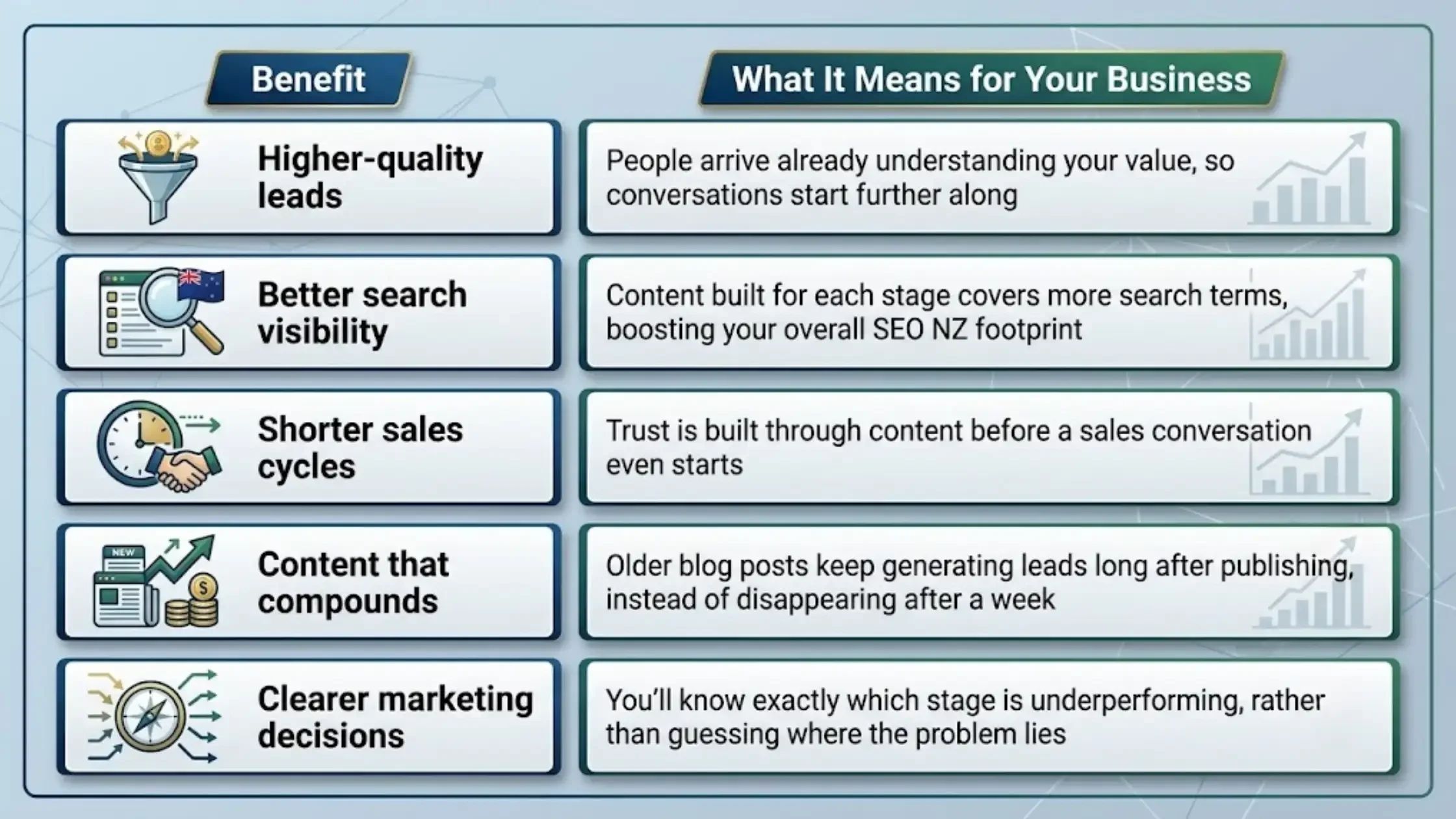
A well-mapped funnel also supports every other channel you're running. Your email marketing strategy works better when it nurtures Consideration-stage leads rather than blasting the same offer to everyone. Your ads perform better when they send traffic to content that already matches funnel stage and intent, rather than a generic homepage.
Bringing It All Together for Your Business
Building a content marketing funnel isn't about writing more content — it's about writing the right content, in the right order, for where your audience actually stands. Awareness content earns attention. Consideration content earns trust. Decision content earns the sale. Skip a stage, and you'll wonder why "good content" isn't translating into growth.
If you're a New Zealand or Australian business ready to map out a funnel that actually works for your market — one built on local search behaviour, genuine trust-building and a clear path to conversion — Wild Sea Creative can help you put it together properly. You can also explore how this connects with Google SEO strategy services in Nelson, NZ to make sure your funnel is backed by strong search foundations from the ground up.
Ready to Build Your Funnel?
If your content feels scattered and your leads feel unpredictable, it's time for a funnel that actually connects the dots. Get in touch with Wild Sea Creative to map out a content strategy built for your business, your market and your growth goals — or explore the full range of services on offer to see where you could start.
Frequently Asked Question (FAQs)
-
Most NZ agencies combine local SEO content for Awareness, in-depth guides and case studies for Consideration, and clear service pages for Decision. The strongest strategies also tailor content to Kiwi search habits rather than copying overseas templates.
-
Start small: map one blog post, one trust-building piece and one clear offer page to each funnel stage. Track which stage gets the least traffic, then focus your next content there before adding more.
-
Look for agencies with proven local case studies, not just generic marketing claims. Wild Sea Creative offers funnel-focused content and SEO strategy built specifically around New Zealand and Australian search behaviour.
-
The three core stages are Awareness (getting found), Consideration (building trust) and Decision (prompting action). Each stage needs different content types matched to where your audience sits in their buying journey.
-
They turn one-time visitors into repeat customers by nurturing trust before the sale and following up after it. Product guides, comparison content and email nurturing all work together to reduce cart abandonment and boost lifetime value.
-
Look for agencies offering both strategy and hands-on content creation, not just advice. Wild Sea Creative provides end-to-end funnel content, from awareness blogs through to conversion-focused service pages.
-
Many Kiwi marketers use tools like Mailchimp for email nurturing, HubSpot for tracking funnel stages, and Google Analytics for measuring which content converts. The right tool depends on your budget and business size.
-
Platforms like Mailchimp, ActiveCampaign and Buffer help schedule and personalise content by funnel stage. Automation works best once your funnel content itself is already mapped and written correctly.
-
Successful NZ examples typically show a blog answering a common question, followed by a detailed case study, then a clear, low-friction booking or contact page. The pattern matters more than the industry.
-
Follow up with helpful, non-pushy content rather than constant sales messages. Segment your emails by funnel stage, and always give leads a clear, simple next step rather than multiple competing calls to action.
