
Video Marketing ROI for B2B: From Scripts to Sales Impact

The Problem Nobody Wants to Admit Out Loud
You've made the videos. The explainer sits on your homepage. The demo lives on your LinkedIn page. The founder interview is buzzing away on YouTube. And yet, when someone in finance asks "what did we actually get for that spend?", you go quiet.
You're not alone. Most B2B teams across New Zealand and Australia can tell you how many views a video got. Very few can tell you how many of those views turned into a qualified lead, a demo booking, or a signed contract. That gap between "people watched it" and "it made us money" is exactly where video budgets get cut, careers stall, and good creative work goes unrecognised.
Video works for B2B, but only when it's tied to a measurable stage of your sales funnel, not just view counts.
Most B2B marketers now say video delivers strong returns, yet fewer than three-quarters actually connect it to pipeline or revenue.
ROI comes from matching the right video type to the right funnel stage, then tracking it through to a sale.
A simple framework — plan, produce, place, prove — turns "nice video" into "profitable video."
Wild Sea Creative helps NZ and AU businesses build video strategy around this exact framework. Have a look at our services to see how it works.
Key Takeaways
Video ROI is the relationship between production cost and business outcome — not just views.
Match every video to a specific funnel stage and buyer question.
Track form fills, sales-cycle length, and win rate — not just watch time.
Connect your video platform to your CRM to close the measurement loop.
Treat video as an ongoing programme, not a one-off project.
What "Video Marketing ROI" Actually Means for B2B
Before you spend another dollar on production, it helps to get clear on what you're actually measuring. Video marketing ROI for B2B is the relationship between what you spend making and running a video (scripting, filming, editing, promotion) and what it returns in business terms — leads, sales meetings, shortened deal cycles, or closed revenue.
This is different from consumer video marketing, where a "win" might simply be brand recall or a viral moment. B2B buying is slower, more considered, and usually involves several people signing off before a deal closes. A single explainer video rarely closes a sale on its own. Instead, it does one job well: moving a buyer from confused to convinced at a specific point in their journey. Your job is to know which point that is, and to measure it.
Broadly, B2B video ROI splits into three sub-categories worth understanding on their own terms:
Production ROI — what it costs to make the video versus the quality and usability of the finished asset.
Distribution ROI — how efficiently the video reaches the right audience across LinkedIn, email, your website, and paid channels.
Conversion ROI — whether the people who watch actually move forward in your funnel.
Most businesses only track the first two. The third is where the real answer lives.
Why B2B Buyers Are Watching More Video Than Ever
Here's the part that should grab your attention: video adoption among businesses has climbed to near-universal levels, and the overwhelming majority of marketers now say it delivers a positive return. B2B buyers increasingly watch video during the purchase process itself — not just for entertainment, but to understand a product before they'll agree to a sales call.
That shift matters for you because it changes where video sits in your funnel. It's no longer a "nice to have" at the awareness stage. Buyers now expect a short, clear video to exist at nearly every step — a two-minute explainer before they'll book a demo, a customer story before they'll ask for pricing, a product walkthrough before they'll loop in a colleague.
If your competitors have this and you don't, you're not just missing an engagement opportunity. You're making the buyer's job harder, and in B2B, the easiest vendor to say yes to usually wins.
The Real Cost of Guessing: Common Video ROI Mistakes
This is usually where interest turns into concern, and rightly so. A few patterns show up again and again in NZ and AU businesses trying to make video work:
Mistake one: measuring the wrong thing. Views and watch time feel good in a monthly report, but they don't pay the bills. A video with modest views that influences three enterprise deals is worth more than a viral clip that influences none.
Mistake two: no link between video and CRM. If your video platform and your CRM don't talk to each other, you cannot prove a video touched a deal. This is the single biggest reason video ROI conversations stall in the boardroom.
Mistake three: one video, no funnel plan. A single glossy brand film does not serve someone who's three meetings deep into evaluating your product against a competitor. Different buyers need different videos at different moments.
Mistake four: treating video as a one-off project. The businesses seeing genuine returns treat video the way they treat SEO or paid search — as an ongoing programme with a strategy behind it, not a single sprint before a trade show.
If any of these sound familiar, you haven't failed. You've simply been missing the framework that connects video to sales — and that's fixable.

From Script to Sale: How Video Moves Through Your Funnel
Now for the part that builds genuine desire for a better approach — seeing exactly how video should map to your buyer's journey, stage by stage.
Top of Funnel: Earning Attention
At this stage, your buyer doesn't know you exist yet, or barely does. Short, punchy videos under two minutes — explainers, "problem" videos, thought-leadership clips — work best here. The goal is not conversion; it's recognition. Measure this stage with reach, watch-through rate, and branded search lift, similar to how you'd assess early-stage content in a full-funnel marketing strategy.
Middle of Funnel: Building Consideration
Your buyer now knows the problem and is comparing options. This is where product demos, customer testimonials, and "how it works" videos earn their keep. Buyers at this stage want proof, not persuasion. Track this with form-fill rate after viewing, email click-through, and time spent on your services pages.
Bottom of Funnel: Closing the Deal
By now, your buyer is deciding between you and a competitor, or between "yes" and "not yet." Short personalised videos — a sales rep walking through a proposal, a founder addressing a specific objection — outperform generic content here. Track this against sales-cycle length and win rate, and tie it directly to closed revenue in your CRM.
The pattern across all three stages is the same: match the video to the question the buyer is silently asking, and track what happens next.
Metrics That Actually Prove ROI
Here's a straightforward way to think about which numbers matter at which stage, and how to read them without a data science degree.
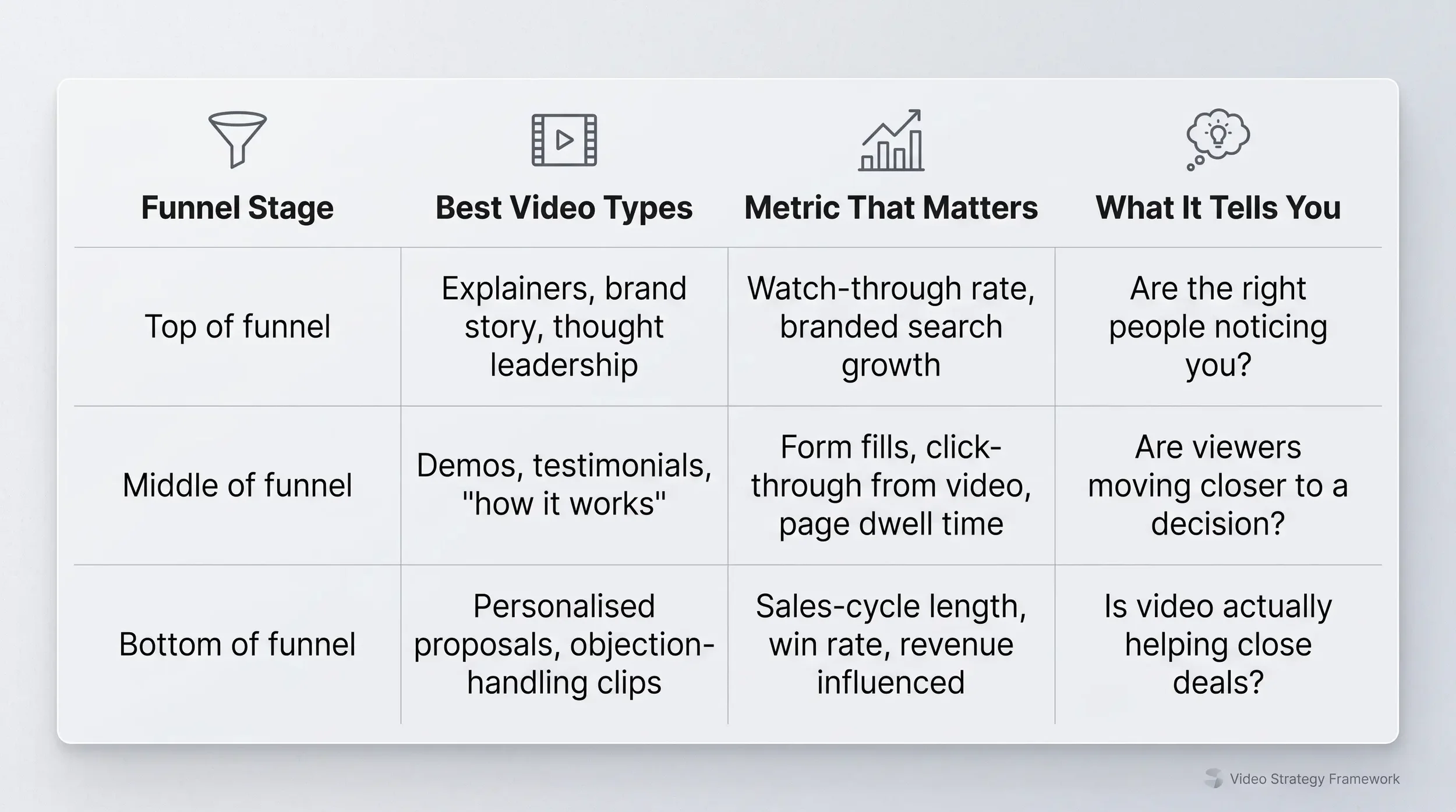
A good rule of thumb: if you can't draw a straight line from a metric to a business outcome, it's a vanity number. Keep it if it's useful context, but never lead your ROI report with it.
Key Benefits of a Measurable Video Strategy
Once video is properly tracked, the benefits compound quickly:
Shorter sales cycles. Buyers who've already seen a demo or testimonial arrive at sales calls further along, cutting weeks off the decision process.
Higher-quality leads. Video tends to attract people genuinely evaluating a purchase, not casual browsers, because it demands more attention than a quick scroll.
Stronger trust before the first call. A well-made video signals competence and credibility long before a salesperson says a word — a form of earned trust rather than claimed trust.
Reusable, compounding assets. Unlike a single ad, a well-made explainer or testimonial keeps working across your website, email nurture sequences, and social channels for years.
Clearer budget conversations. Once you can show video's contribution to pipeline, next year's budget approval becomes a formality rather than a fight.
Building Your Video ROI Framework: A Step-by-Step Approach
This is the action stage — the part where insight becomes a plan you can actually run with.
Step 1: Plan Against the Funnel, Not the Calendar
Before you script a single video, map it to a funnel stage and a specific buyer question it needs to answer. A video without a stated job is a video without a measurable outcome.
Step 2: Produce for Clarity Over Polish
B2B buyers value clarity far more than cinematic flair. A well-scripted, well-lit video shot on a good camera will usually outperform an expensive production that fails to answer the buyer's actual question.
Step 3: Place It Where Your Buyer Already Is
Distribution matters as much as production. LinkedIn, targeted email sequences, and your own service pages typically outperform a video left to find its own audience on YouTube alone.
Step 4: Prove It With a Closed Loop
Connect your video platform to your CRM so you can see which contacts watched which video before which stage change. Without this loop, you're guessing dressed up as analysis. This is the same discipline behind sorting genuine traffic from real conversions elsewhere on your site.
Ready to Turn Views Into Revenue?
If you've read this far, you already suspect your video content could be doing more for your pipeline than it currently is. That instinct is usually right.
Wild Sea Creative works with NZ and AU businesses to build video and content strategy around actual funnel stages, not guesswork. Whether you need a first video strategy built from scratch or want to audit what you already have, our team can help you connect content to sales. Get in touch through our services page, explore our approach to social media marketing, or read more on our blog before you decide.
Bringing It All Together
Video isn't short of proof that it works for B2B — the evidence for that is now overwhelming. What's been missing for most businesses is the discipline to connect it to something a finance team can see on a spreadsheet. Once you map your videos to funnel stages, choose the right metric for each stage, and close the loop between your video platform and your CRM, the ROI conversation stops being a guessing game and starts being a genuine business case.
You don't need to overhaul everything at once. Start with one funnel stage, one video, and one metric you can track cleanly. Prove it works, then scale from there.
Frequently Asked Question (FAQs)
-
It's the return your business gets from video content compared with what you spent creating and distributing it — measured through leads, shortened sales cycles, or closed revenue, rather than views alone.
-
Track outcomes tied to each funnel stage: watch-through rate for awareness videos, form fills for consideration videos, and win rate or revenue influenced for bottom-of-funnel videos, ideally through your CRM.
-
Short explainer videos and customer testimonials tend to perform strongly for lead generation, since they build trust and clarify value quickly for a buyer who's still comparing options.
-
Shorter is usually better. Videos under two minutes tend to hold attention best for top-of-funnel content, while bottom-of-funnel videos can run slightly longer if they're answering a specific objection.
-
Yes, in most cases. Buyers who watch relevant demo or testimonial videos before a sales call typically arrive better informed, which reduces the number of meetings needed to reach a decision.
-
It depends on your team's capacity and skill. Many NZ and AU businesses use a mix — in-house for quick, low-cost clips and an agency for higher-stakes explainer or brand videos that need stronger strategy behind them.
-
Budgets vary widely, but a sensible starting point is to fund one video per funnel stage rather than one large brand film. This spreads risk and gives you data across the whole buyer journey sooner.
-
Views measure attention; ROI measures outcome. A video can have modest views and still deliver excellent ROI if it reaches the right decision-makers and moves them toward a sale.
-
Video increases time on page and engagement signals, which can support search rankings, and it often earns backlinks and shares more easily than text alone — complementing a broader SEO strategy.
-
Consistency matters more than volume. A steady cadence of one well-targeted video a month, mapped to a funnel stage, will typically outperform an irregular burst of many videos with no clear plan.
