
Website Redesign ROI: How to Justify the Investment and Measure Results

The Question Nobody Wants to Ask Out Loud
Here's the honest bit: most businesses put off a website redesign because they're not sure it'll be worth the money. You've probably had the thought yourself — what if we spend thousands and nothing actually changes? It's a fair worry. A redesign is one of the few marketing investments where the bill lands upfront and the payoff, if it comes at all, trickles in over months. That gap between spending and seeing results is exactly where good projects stall and get quietly shelved.
The good news is that website redesign ROI isn't a mystery. It's a calculation, not a gamble, once you know which numbers to track and when to start tracking them.
Website redesign ROI is worked out by comparing what you spend on the project against the extra revenue, leads, or cost savings it generates afterwards.
The formula is simple: (Gain from redesign − Cost of redesign) ÷ Cost of redesign × 100.
Track a "before" baseline for at least 30 days prior to launch, then compare the same metrics 60–90 days after.
Conversion rate, lead quality, bounce rate, and page load speed matter more than raw traffic.
Most NZ and Australian small businesses start seeing measurable shifts within 8–12 weeks of a well-planned redesign going live.
Key Takeaways
ROI = (Gain − Cost) ÷ Cost × 100 — keep the formula simple and consistent.
Include internal time and maintenance in your cost calculations, not just the invoice.
Track conversion rate, bounce rate, and lead quality over raw traffic numbers.
Allow 60–90 days post-launch before judging results.
Partnering with a team that builds tracking in from the start saves guesswork later.
What Website Redesign ROI Actually Means
Website redesign ROI is simply the financial return you get back from redesigning your site, measured against what you paid to have it done. It sounds obvious, but plenty of businesses skip this step entirely. They redesign because the old site "looks tired," then never circle back to check whether the new one is actually working harder for them.
Done properly, ROI tracking turns a vague feeling ("the new site seems better") into a number you can defend in a budget meeting. That number is what separates a design refresh from a genuine business investment.
Why So Many Businesses Hesitate to Redesign
You're weighing up a real cost against an uncertain future — that's the root of the hesitation, and it's completely reasonable. A redesign touches your budget, your team's time, and sometimes your search rankings if it's handled poorly. Add in a bad experience from a previous project, or a colleague's horror story about a six-month delay, and it's easy to see why "let's just leave it for now" becomes the default answer.
But leaving it isn't free either. An outdated website has a cost too — it's just harder to see because it shows up as missing revenue rather than a line item on an invoice. Visitors who land, feel unsure, and leave without contacting you never show up in an obvious "loss" column. They just don't convert, and you're left wondering why enquiries have flattened out.
The Real Cost of an Outdated Website
Design credibility matters more than most business owners expect. Research on user trust consistently shows that people form an opinion about a website's credibility within seconds of arriving, largely based on visual design rather than content. If your site looks dated, visitors quietly assume your business might be too — even if your service is excellent.
That first impression compounds. A confusing menu, slow load times, or a site that doesn't work properly on a phone will push people back to the search results before they've read a word of your copy. If you're already seeing this pattern, it's worth reading our guide on what to do when your website isn't generating leads — it covers the early warning signs that a redesign might genuinely pay for itself.

How to Calculate Your Website Redesign ROI
This is the part most guides gloss over, so let's make it practical.
The Basic ROI Formula
The standard formula looks like this:
ROI (%) = (Financial Gain − Cost of Redesign) ÷ Cost of Redesign × 100
Say your redesign costs $12,000, and over the following year it generates an extra $30,000 in trackable revenue from website enquiries. Your ROI would be (30,000 − 12,000) ÷ 12,000 × 100 = 150%. That's a number you can put in front of anyone.
What to Include in Your Investment Costs
Your "cost" side should cover more than just the design invoice. Include the following:

Leaving out internal time is one of the most common mistakes — it makes the true cost look smaller than it is, which throws off your ROI later.
What Counts as a Return
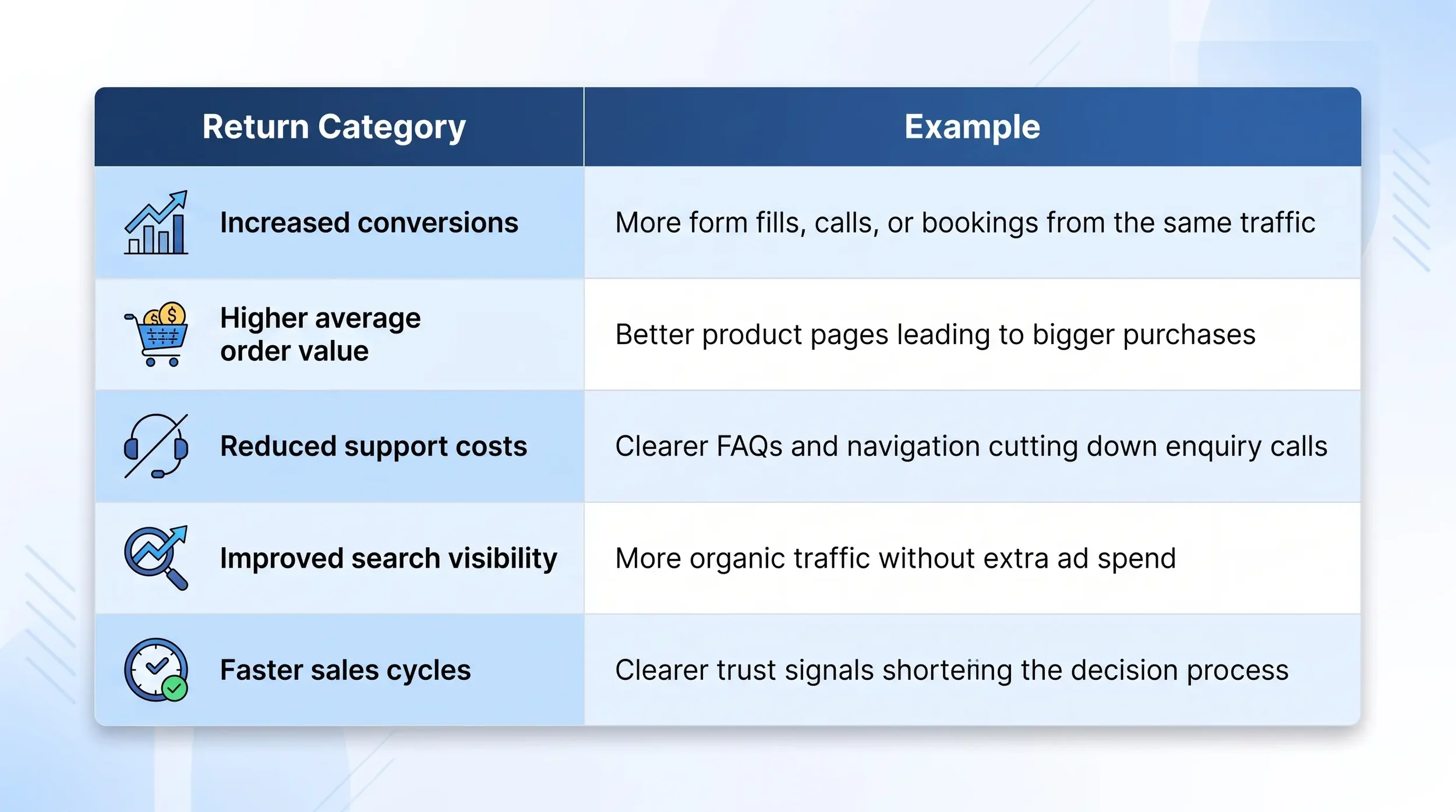
On the return side, look at anything that ties back to money, saved time, or reduced risk:
Key Metrics That Prove Your Redesign Is Working
Numbers only mean something if you're watching the right ones. Traffic alone tells you very little — you can have a 40% traffic increase and still lose money if none of those visitors convert. Focus on metrics that connect directly to business outcomes.
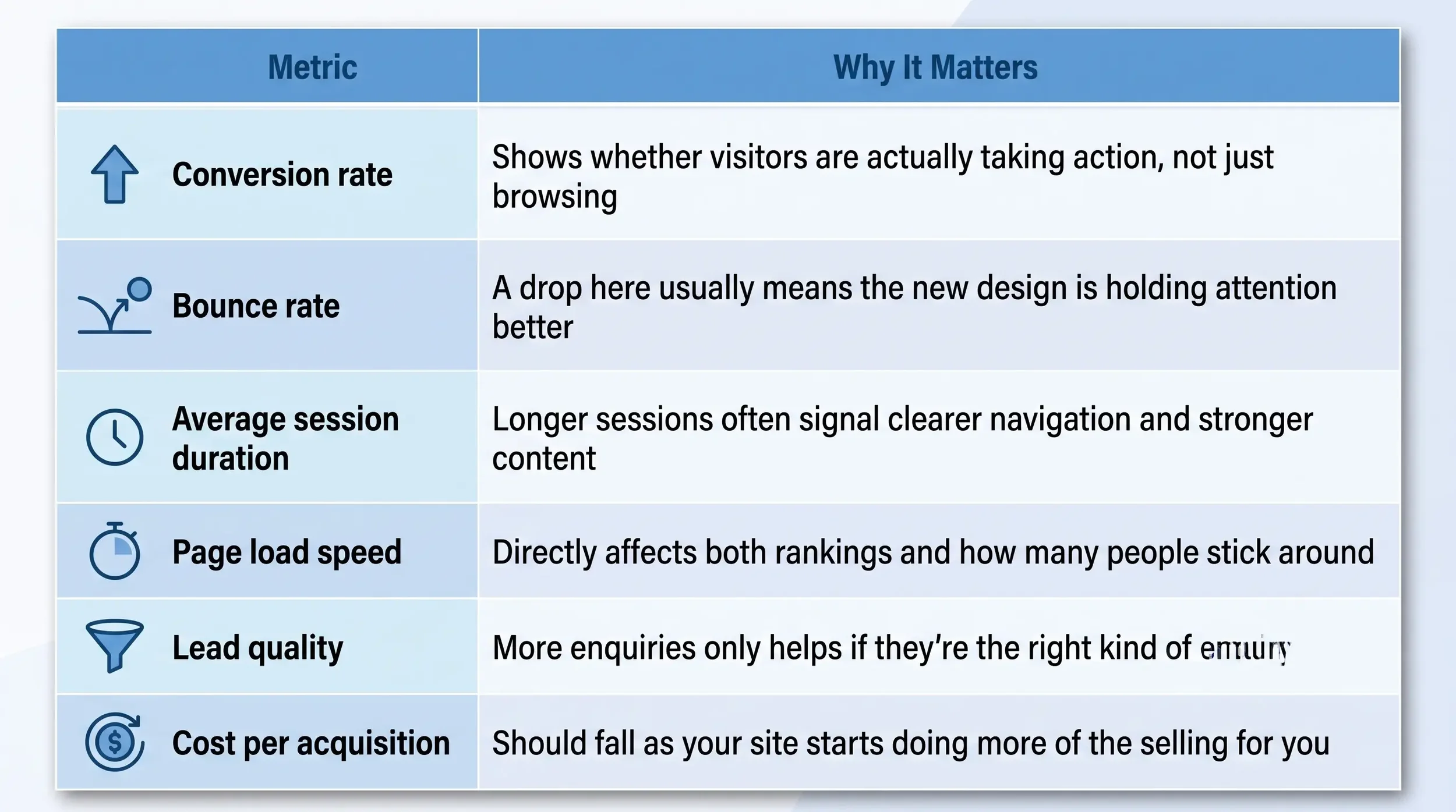
If you're unsure which of these to prioritise for your business type, our piece on website traffic vs conversions breaks down the difference in plain terms.
Real-World Signs Your Redesign Is Paying Off
You'll usually notice a handful of practical signs before the spreadsheet confirms it. Enquiries start sounding more informed, because visitors have actually read your service pages instead of guessing. Your sales team spends less time explaining basics that used to live buried three clicks deep. And your bounce rate on mobile — often the weakest point on an old site — starts to even out with desktop.
None of these show up overnight. Search engines need time to re-crawl and re-rank your new pages, and visitors need a few touchpoints before they trust a new layout enough to convert. Give it a proper 60–90 day window before drawing conclusions.
How Wild Sea Creative Helps You Track and Maximise ROI
This is where having the right partner matters. At Wild Sea Creative, every redesign is built with measurement baked in from day one — not bolted on afterwards as an afterthought. Our team, led by Nish, sets up conversion tracking, benchmarks your "before" numbers, and reports back on the metrics that actually connect to revenue.
If SEO visibility is part of your worry, our Google SEO strategy services are designed to protect and grow your rankings through a redesign rather than risk them. And because a beautiful layout with weak copy still won't convert, our copywriting services make sure every page is pulling its weight. You can see the full scope of what's involved on our services page.
Key Benefits of Tracking Redesign ROI
Measuring ROI properly gives you more than just bragging rights for the next board meeting.
Clear budget justification — you can show exactly what the spend delivered, in real numbers.
Better future decisions — you'll know which pages or features to invest in again next time.
Stronger internal buy-in — teams trust a redesign backed by data far more than one backed by opinion.
Early warning signs — if something isn't working, you catch it in month two, not month twelve.
Ready to See What Your Website Could Be Earning?
If you're still weighing up whether a redesign is worth it, the honest answer is: it depends on your current numbers, and the only way to know for sure is to look at them properly. Get in touch with Wild Sea Creative for a straightforward chat about your website's current performance and what a redesign could realistically return for your business.
The Bottom Line on Website Redesign ROI
A website redesign isn't a leap of faith — it's a business decision that can, and should, be measured like any other. Set your baseline, agree on the metrics that matter before you start, and give the results time to show up. Businesses across New Zealand and Australia that treat their redesign this way tend to stop asking "was it worth it?" and start asking "what should we improve next?"
Frequently Asked Question (FAQs)
-
A "good" ROI varies by industry, but many businesses aim for at least 100–200% return within 12 months. Service-based businesses with high customer value often see stronger returns than low-margin retail sites, so compare your results against your own baseline rather than industry averages alone.
-
Most businesses start noticing measurable changes within 60–90 days of launch. Full ROI, including search ranking improvements, can take 6–12 months to fully materialise, especially for organic traffic and SEO-driven gains.
-
Use the formula: (Financial Gain − Cost of Redesign) ÷ Cost of Redesign × 100. Include all costs — design, development, copywriting, and internal time — against all measurable gains, such as new leads, sales, or reduced support enquiries.
-
Conversion rate, bounce rate, average session duration, page load speed, and lead quality are the most reliable indicators. Traffic alone isn't enough — a redesign should improve how visitors behave once they arrive, not just how many show up.
-
It can, both positively and negatively. A poorly planned redesign risks losing rankings through broken URLs or missing redirects. A well-planned one, with SEO considered from the start, typically improves rankings through better speed, structure, and content.
-
Budgets vary widely depending on scope, but small businesses in New Zealand typically invest anywhere from a few thousand to over ten thousand dollars, depending on the number of pages, custom features, and copywriting involved.
-
It depends on your goals and current performance. If only specific pages are underperforming, a targeted refresh may deliver better ROI than a full rebuild. A quick audit usually reveals which approach makes more financial sense.
-
Forgetting to include internal staff time and ongoing maintenance costs. This makes the redesign look cheaper than it really was, which skews the ROI calculation and can lead to unrealistic expectations for future projects.
-
Yes. Clearer navigation, better FAQs, and stronger product or service pages often reduce the number of basic enquiries your team has to handle manually, freeing up time for higher-value conversations with genuinely interested customers.
-
If you're unsure whether the issue is design, content, or technical, start with an audit rather than jumping straight to a full rebuild. It's a cheaper first step and tells you exactly where the ROI opportunity actually lies.
