
What Does Search Engine Optimisation in New Zealand Actually Include in 2026?

Why Your Website Might Be "Doing SEO" and Still Going Nowhere
Here's an honest truth: a lot of Kiwi businesses think they're doing SEO when they're really just guessing.
You've added a few keywords to your homepage. You post when you remember to. You wait for the phone to ring. Meanwhile, a competitor down the road — sometimes a smaller one, with a worse-looking website — keeps turning up first on Google, inside the map pack, and even inside the AI answer that appears before any of the actual search results. That's not luck. Search engine optimisation in New Zealand has changed shape twice over in the last two years, and most of what worked in 2020 barely moves the needle now.
Search engine optimisation in New Zealand in 2026 is no longer a keyword checklist. It's five connected pillars working together — technical foundations, local visibility, E-E-A-T (proving you're genuinely trustworthy), structured data, and AEO/GEO (getting cited inside AI Overviews, ChatGPT and Gemini). Businesses that build all five tend to keep growing. Businesses that only tick one or two usually plateau, then quietly lose ground to whoever didn't.
Key Takeaways
SEO in New Zealand now spans five connected pillars, not a single checklist.
Technical health is the foundation — nothing else works well on a slow or broken site.
Local SEO still wins "near me" searches, but only if your Google Business Profile is accurate and active.
E-E-A-T decides whether Google, and AI tools, trust your business enough to recommend it.
AEO and GEO decide whether you get quoted inside AI Overviews, ChatGPT and Gemini answers.
SEO is ongoing. Algorithms shift, competitors publish, and AI search keeps expanding.
What SEO in New Zealand Actually Means Right Now
Search engine optimisation is the practice of shaping your website so that search engines, and increasingly the AI models sitting on top of them, can understand it, trust it and want to recommend it. That's the plain-English version, and it hasn't changed. What has changed is who you're optimising for.
It used to be one audience: Google's crawler. Today you're optimising for that crawler, plus Google's AI Overviews, plus ChatGPT, Perplexity and Copilot, because a growing share of Kiwis now ask an AI tool a question instead of typing it into a search box. A significant share of Google searches on mobile already end without a click at all — people get their answer straight from the results page. If your business isn't structured in a way these systems can read and trust, you can be invisible in two places at once instead of just one. That's the shift this guide is really about.
What Does an SEO Service Actually Include in New Zealand?
A genuine SEO service in New Zealand in 2026 covers four to five connected pillars, not just content and links. It includes technical health (site speed, mobile usability, crawlability), local visibility (Google Business Profile and location signals), E-E-A-T and digital authority (real expertise, genuine reviews, credible mentions), and AEO/GEO (structuring content so it gets pulled into featured snippets and AI-generated answers). A service that only offers one or two of these is doing partial SEO, not full-spectrum search visibility.
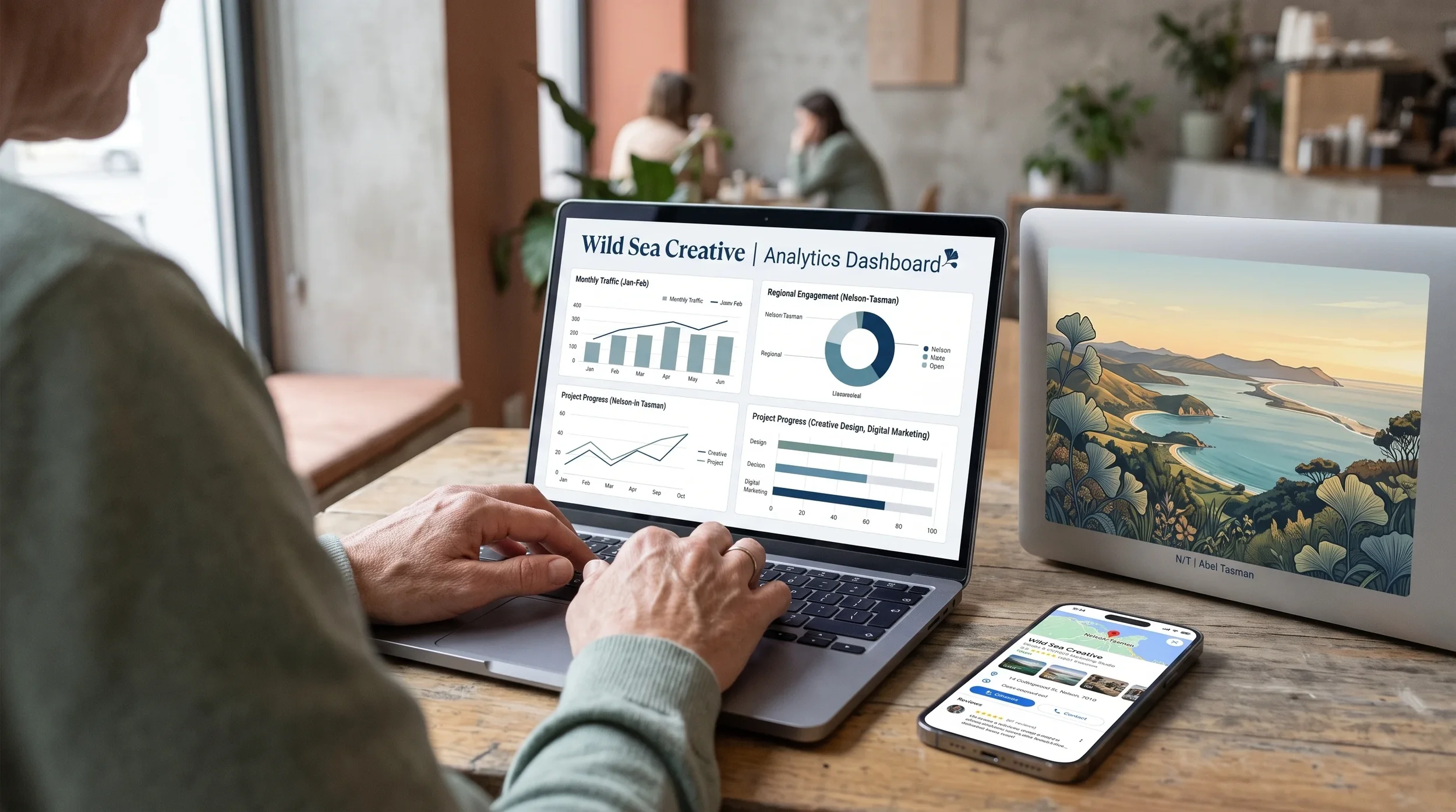
Introducing the Wild Sea 5-Pillar 2026 SEO Framework
Most SEO advice you'll read online still talks about "technical, on-page and off-page" as if it's 2019. It's not wrong, exactly — it's just incomplete for how people actually search today. At Wild Sea Creative, we work New Zealand and Australian clients through a five-pillar framework that folds the AI search layer in properly, rather than bolting it on as an afterthought.
Here's how the old model compares with what we actually build for clients now.

Pillar 1: Technical Foundation
This is the plumbing nobody sees but everyone feels: site speed, mobile usability, secure connections, clean URLs, and making sure Google and AI crawlers can actually reach every page you want found. You could publish the best content in the country, but if your site takes eight seconds to load on a phone in Nelson, most people leave before reading a word. Our SEO strategy services always start here, because nothing else performs well on a broken foundation. Running on Squarespace? Our piece on Squarespace SEO myths holding NZ businesses back clears up the most common ones.
Pillar 2: Local & Map Visibility
Local SEO wins the "near me" search — think "electrician Nelson" or "cafe near me." It runs on your Google Business Profile, consistent business details across the web, genuine reviews and location-specific content. A large share of local searches lead to a call or a visit within a day, so an outdated profile hands that customer straight to a competitor. See our guides to local SEO in New Zealand, our advanced local SEO playbook for 2026, and local SEO beyond Google Maps for the other places NZ customers look.
Pillar 3: E-E-A-T & Authority
E-E-A-T stands for Experience, Expertise, Authoritativeness and Trustworthiness — the lens Google uses to judge whether your business deserves to rank, and whether an AI tool should mention you at all. In practice, this means a real "About" page with a real name and story, genuine reviews instead of copy-pasted testimonials, and mentions from other credible New Zealand sites. It's slow, honest work, closer to reputation-building than a technical task — much like getting to know the person behind Wild Sea Creative rather than a faceless logo. Old-style link building alone no longer earns that trust; see why "link building" is dead for why.
Pillar 4: Machine-Readable Structure
Structured data is a small piece of code that tells search engines exactly what your content is — a review, an FAQ, a business address — instead of leaving them to guess. You've seen it working without realising: star ratings under a listing, an FAQ that expands right on the results page, opening hours shown before you click through. It doesn't just make a listing tidier. It raises the odds that Google and AI tools correctly read and reuse your content, which matters more each month as answers get pulled straight into summaries instead of a list of blue links. Our guide on what makes a website "SEO-ready" in New Zealand goes deeper on this, and our SEO content planning checklist for 2026 shows how to structure content around it from the start.
Pillar 5: Answer & Generative Visibility (AEO + GEO)
This is the pillar most New Zealand websites are still missing, and it's really two disciplines working together. Answer Engine Optimisation (AEO) structures your content so it can be lifted directly as the answer inside featured snippets and voice search. Generative Engine Optimisation (GEO) does the same job for large language models like ChatGPT, Perplexity and Google's Gemini-powered Overviews, which don't list links — they write an answer and quietly cite a handful of sources. To be one of those sources, your content needs to be specific, well-organised and genuinely useful; vague marketing language tends to get skipped entirely. As more Kiwis open an AI tool before they open Google, this pillar is quickly becoming as important as your ranking position. Our piece on how Google really ranks New Zealand websites in 2026 walks through this shift in more detail.

Key Benefits of Working All Five Pillars Together
When technical health, local visibility, E-E-A-T, structured data and AEO/GEO move together, the results compound instead of just adding up. A site strong across every pillar becomes the obvious, already-trusted choice, whether someone finds it through a search, a map listing, or a question typed into ChatGPT. A site strong in only one pillar tends to plateau early, then lose ground as competitors catch up.
This is also where budget conversations get clearer. See our breakdown of SEO costs in New Zealand for how these pillars map to a monthly retainer, and our guide to choosing an NZ SEO provider if you're weighing up who should do the work.
Ready to Get Found in Every Kind of Search?
If reading this made you realise your website is only ticking one or two of these five boxes, you're in good company — most New Zealand and Australian businesses are in the same spot right now. The good news is you don't have to fix everything at once, and you don't have to work it out solo.
Wild Sea Creative builds SEO strategies for New Zealand and Australian businesses that cover all five pillars, not just keywords on a page. Have a look through our SEO services, get to know who's behind the work, or book a free discovery call to find out exactly where your website stands today.
Bringing SEO in New Zealand Into Focus for 2026
Search engine optimisation in New Zealand has grown into something far more layered than it was even two years ago. It's no longer a list of keywords — it's technical health, local presence, genuine trustworthiness, machine-readable structure and visibility inside AI-generated answers, all working as one system. Businesses that understand this, and build for all five pillars rather than one or two, tend to pull well ahead of the ones still doing SEO the old way.
You don't need to master all five overnight. You need to know exactly where your website stands today, and build from there, one solid pillar at a time.
Frequently Asked Question (FAQs)
-
It's the process of shaping your website so it ranks well on Google and gets recommended by AI tools for New Zealand-based searches. In 2026, that covers technical health, quality content, local signals, structured data, and visibility inside AI-generated answers, not just keywords.
-
A full-service SEO agency audits your site's technical health, builds out local visibility through your Google Business Profile, strengthens E-E-A-T signals, adds structured data, and optimises your content so it can be cited inside AI Overviews and tools like ChatGPT, rather than just chasing rankings alone.
-
SEO used to mean ranking in a list of blue links. Now it also means getting quoted inside AI Overviews, ChatGPT and Gemini answers, because more people ask an AI tool a question before they ever open a search bar. The fundamentals haven't disappeared, but the target has widened.
-
SEO covers your overall search visibility. AEO (Answer Engine Optimisation) focuses on getting pulled into featured snippets and voice answers. GEO (Generative Engine Optimisation) focuses on getting cited inside AI-generated answers from tools like ChatGPT. All three now work together as one strategy.
-
Most businesses see early movement within three to six months, with stronger results building over six to twelve months. Timelines depend on your industry, your competitors, and how much technical and content work your website needs before it's genuinely competitive.
-
E-E-A-T stands for Experience, Expertise, Authoritativeness and Trustworthiness. It's how Google, and increasingly AI tools, judge whether your business deserves to rank or be recommended. Real authorship, genuine reviews and credible mentions all build it over time.
-
Yes, increasingly so. Even small, local businesses are being asked about inside ChatGPT and Google's AI Overviews when customers research options nearby. Skipping AEO and GEO means missing an entire discovery channel that's growing every month, alongside traditional search.
-
Costs vary by goals, competition and your website's current condition, but it's best treated as an ongoing investment rather than a one-off fee. Full-spectrum SEO covering all five pillars costs more than basic keyword work, and typically delivers results that keep compounding.
-
Local SEO targets searches tied to a specific area, like "near me" or a suburb name, and relies heavily on your Google Business Profile. General SEO covers your visibility across broader search results and AI answers, regardless of the searcher's location.
-
It depends on your time, budget and how technical your website's needs are. Many businesses start with expert guidance to build the technical and E-E-A-T foundations properly, then maintain momentum with ongoing support once the fundamentals are solid. Our SEO agency vs SEO consultant guide breaks down which option suits which situation.
